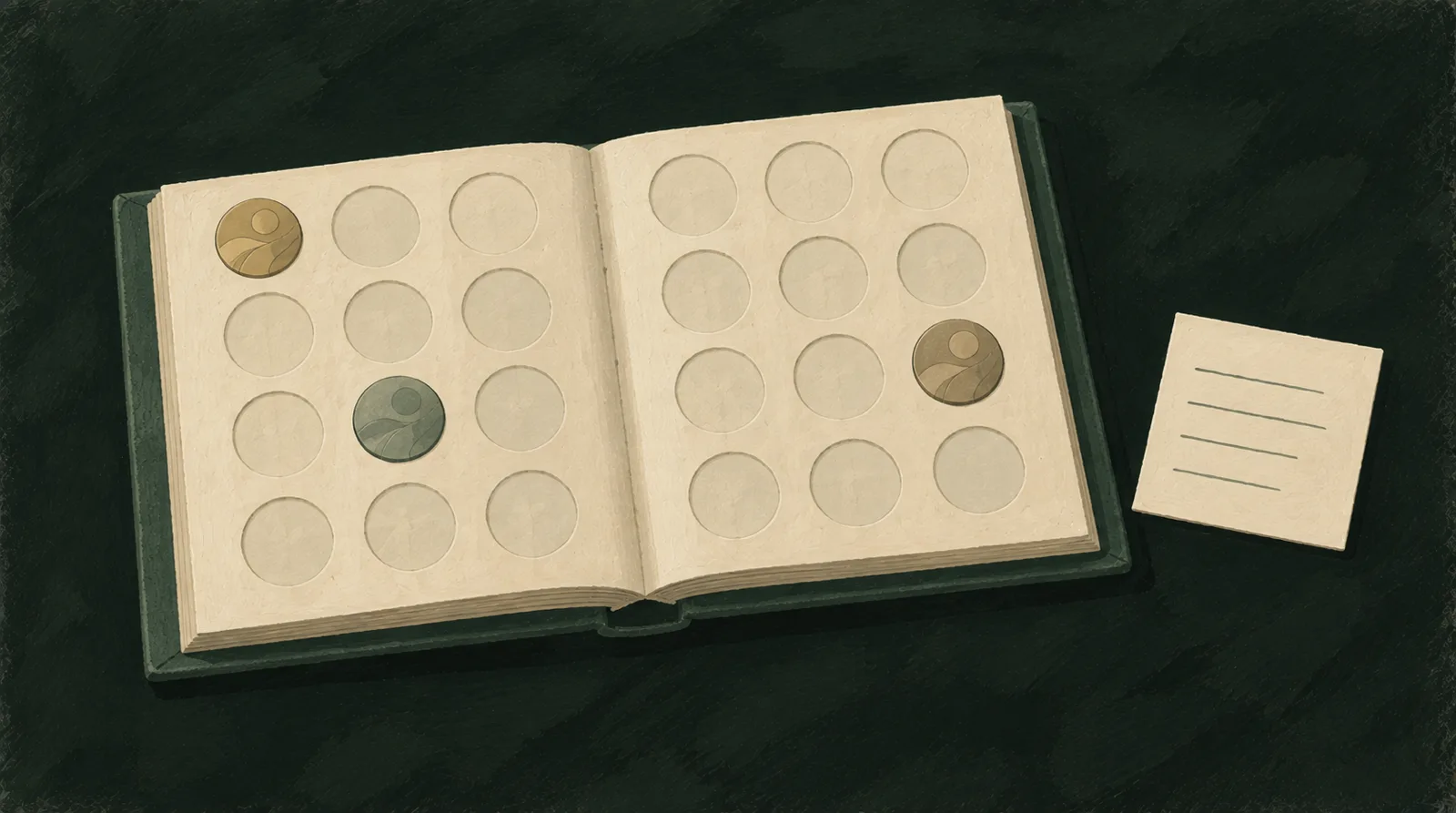
Collecting advice usually starts with what to buy. Better advice starts with what you are building. A collection is a set of decisions — about scope, spending, documentation and storage — and the beginner who makes those decisions before the first purchase spends the year assembling something instead of accumulating something. None of this requires expertise on day one; it requires a shape for the expertise to land in. The rest of the guide library supplies the depth for each stage as you reach it.
Pick a shape before you buy
A collection needs a boundary — not to limit it, but to make every new coin answerable to a slot. Collectors organise around themes (a subject, a country, an era), type sets (one example of each design in a series) and date runs (the same design across the years it was struck). The vocabulary for all of it is mint-standard: the Royal Australian Mint's coin glossary is a compact reference for terms like type, variety, mint mark and commemorative as you draw your boundary. Royal Australian Mint: Coin Glossary
The shape changes what "good buying" means. A theme turns impulse lots into noise; a type set makes each purchase visibly different from the last; a date run turns "which year is missing" into the shopping list. Mints design for exactly this habit — the U.S. Mint's collecting-basics pages exist to orient people starting a collection, and its anatomy guide teaches the part-names that catalogue descriptions assume. Start narrower than feels ambitious: "UK circulating commemorative 50p designs" teaches faster than "interesting coins". U.S. Mint: Anatomy of a Coin, Coin terms glossary
Four decisions before the first coin
Theme, type set or date run — the slot every coin must answer to.
A figure decided in the abstract, before any coin argues its case.
What it is, where it came from, what it cost — from day one.
Inert, PVC-free, and expandable rather than decorative.
Editorial plan for a first collecting year; it recommends no purchase. Evidence: U.S. Mint: Anatomy of a Coin; American Numismatic Association; Royal Australian Mint: Coin Glossary.
A budget that survives enthusiasm
Decide the year's figure while it is still abstract — a monthly amount, a per-coin ceiling, or both — because every coin you will ever want arrives wrapped in a reason why this one is the exception. A pre-committed number converts "can I justify this?" into "does this fit?", which is a much faster question. Keep a reserve for the boring parts: holders, an album, a loupe and a scale all outlast any single coin.
Treat the spend as hobby money, not savings. "Investment" framing in listings is a sales argument wearing a financial costume — prices move, grading is opinion, and nobody reputable promises appreciation. The American Numismatic Association, the US nonprofit collector-education organisation, frames collecting as education and community rather than wealth-building; that is the spirit to borrow. If a seller leads with returns, the counterfeit-and-replica guide covers the adjacent risks, and the value-drivers guide shows how little of a coin's price a beginner's enthusiasm controls. American Numismatic Association
Where beginner coins come from
Circulation first: it costs face value and teaches identification faster than any book — the pocket-change guide lists what justifies a second look. Then the deliberate sources: local coin shops and club meetings, dealer tables at shows, and mints' own commemorative issues. When buying online or from anyone new, prefer established dealers — the ANA maintains a dealer directory as part of its collector resources, and the dealers-and-services guide maps who does what before money moves. American Numismatic Association
Two beginner magnets deserve a warning label. Bulk "mystery" lots teach you to sort, which is real — but they price in a storyteller's markup on junk. And inherited or gift coins should go through the first-weeks sequence before anything is sold or scattered. For every other unfamiliar candidate, the loop is: look it up in a catalogue, check the listing's finish and grade words against the finish-labels and grade-terms guides, then decide.
Records worth keeping from day one
A collection's paperwork is cheap on day one and impossible to rebuild on day four hundred. For each coin record: what it is (issuer, denomination, date, the catalogue reference once you've checked it — the catalogue-entry guide shows where to find it), where and when you got it, what you paid, and a sentence on condition in your own words. A photo of both sides belongs with the record; the photo guide covers a repeatable setup.
These notes pay off three ways. They stop duplicate purchases, a common beginner waste. They document what you own for insurance or the next person to inherit it. And they quietly teach grading-adjacent observation — writing "light wear on the hair detail, full rim" every week is how a beginner's eye becomes a collector's eye.
Storage that grows with you
Storage has one non-negotiable and one scaling rule. Non-negotiable: inert materials — the care guide details PVC-free holders and acid-free options, because soft PVC flips corrode coins over time into the green residue the surface-problems guide teaches you to recognise. Scaling rule: store for the collection you'll have next year — a flip-and-box start is fine, but pick formats (2x2 holders, album pages, capsules) that let you add without rebuying everything.
Keep the collection dry, handled by the edges, and out of improvised containers — conservation guidance puts low humidity at the centre of metal storage, and cheap storage is a costly beginner mistake precisely because its bill arrives years late. Buy holders before you buy coins that need them.
When a photo tool helps
A new collector meets unfamiliar coins constantly — in change, in bulk lots, in the inherited tin. Coin Says Hi gives a possible photo reading: a match candidate, visible clues, and alternatives. In the beginner's loop it plays one role — a starting point for the catalogue lookup, not an endpoint. The reading proposes; your record gets written when the catalogue confirms.
That boundary matters more than the convenience: the tool does not authenticate, grade or value, and the habits that protect a beginner — verify against the catalogue, question finish words, distrust urgency — are the same habits the tool is designed to feed rather than replace. Try it on an unfamiliar coin.
Questions people ask
How much should I spend in the first year?
Whatever you would comfortably spend on any hobby you are still auditioning. The figure matters less than pre-deciding it — set a monthly or annual number before the coins get a vote.
Type set or date run for a first collection?
A type set is the friendlier start: every acquisition looks and feels different, and each new design teaches you a new entry in the catalogue. Date runs reward patience and suit collectors who already love a specific design deeply enough to chase its scarcer years.
Is coin collecting a good investment?
Treat it as a hobby. Some coins appreciate and some don't, "investment" framing in a listing is marketing rather than analysis, and the skills that protect a collector — verification, patience, records — are worth more than any single early purchase.
Do I need to buy anything to start?
No. Circulation costs face value, catalogues are free to consult online, and the first records fit in a notebook. Spend on holders before hardware, and on reference knowledge before specimens.
Where does Coin Says Hi fit for a beginner?
As the fast first pass on unfamiliar coins: a possible match to look up, plus the visible clues to check. It sits between "no idea what this is" and the catalogue entry — a research lead, never a verdict. Try it on your coin.
Sources and scope
The U.S. Mint's collecting-basics pages support the orientation-to-collecting and anatomy framing; the cited URL is the Mint's canonical collecting-basics entry point, already cited across this site. The American Numismatic Association's site supports the collector-education framing and the dealer-directory reference. The Royal Australian Mint's coin glossary supports the collecting-vocabulary references. Collecting conventions and dealer protections vary by country — the principles here (shape, budget, records, inert storage) travel, but local buying routes and consumer protections differ. Sources last checked 2026-10-01.
Spotted an error? Tell us — include the page address and what seems wrong.