The care guide is about prevention — how to store coins so problems never start. This guide starts from the other end: the problem is already on the coin, and the question is what it is. The sorting question underneath everything below is deceptively simple: is this surface stable, or is it still changing?
A photo — and this site — cannot answer that chemically. What follows is the vocabulary and the triage logic that conservation professionals and grading services use, so you can describe what you see, know what can wait, and know what cannot. Surface problems also change what an identification attempt can see — the identification guide covers the features a reading leans on, several of which corrosion obscures.
Toning versus damage
Toning is corrosion too — just a welcome kind. The Canadian Conservation Institute describes toning on silver as a film of silver sulphide whose colour depends on its thickness, running from yellow and red through to blue and black. Many numismatists prize patinas and toning that develop over time, and toned silver in particular can be a selling point rather than a flaw. CCI: Basic Care of Coins, Medals and Medallic Art, Note 9/4
Damage is the same chemistry without the courtesy. Grading services draw the line between discoloration and actual corrosion: NGC's details-grading glossary treats "stained" coins as discoloured but not corroded, while corrosion means the surface has formed new molecular compounds — metal being converted, not just tinted. The practical distinction: a toned coin's metal is intact under a stable film; a corroding coin is losing itself. NGC: Details Grading
Stable or still changing?
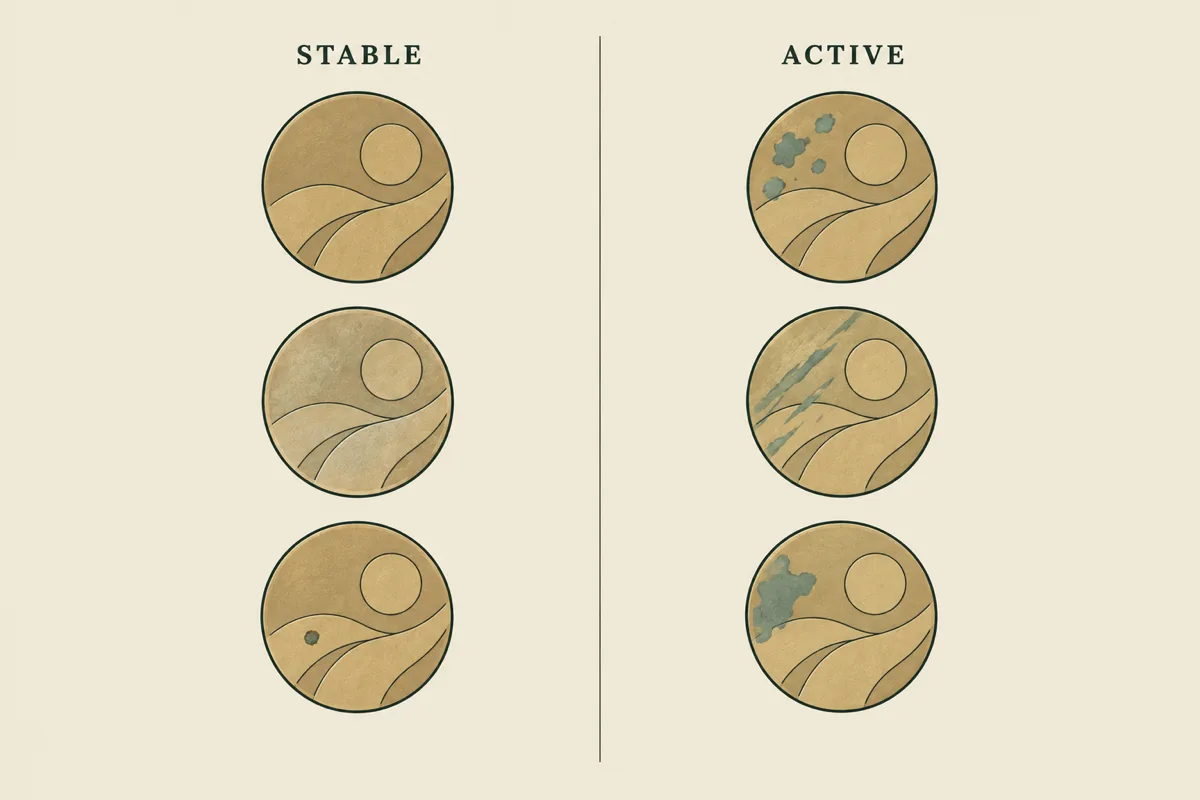
- Stable-leaning · dry, hard, even colour; unchanged between photographs months apart
- Watch · haze, films and prints — record them and rehouse before judging
- Active-leaning · powdery or raised spots, sticky residue, growth over time
- Act now · isolate first, photograph second, leave treatment to a conservator
Editorial triage aid; not a diagnosis. Evidence: CCI Note 9/4; NGC: Details Grading.
PVC residue — the ‘green slime’
Soft, flexible coin flips sold for decades were often made of polyvinyl chloride, and PVC is the classic preventable disaster of coin storage. CCI's care note explains the mechanism plainly: the plasticizer in PVC is particularly corrosive to copper-alloy coins, producing a green corrosion product commonly called green slime — and silver coins with a high copper content can suffer the same attack. The tell-tale is a greenish, sometimes sticky or greasy film, worst where the plastic touched the coin. CCI: Basic Care of Coins, Medals and Medallic Art, Note 9/4
The response has a correct order. First, get the coin out of the PVC — CCI advises rehousing into archival-quality holders made of inert plastics such as polyethylene, polypropylene or Mylar, and the care guide walks through holder choices. Then stop: the slime is a corrosion product bonded to the surface, and whether a gentle wash helps or harms is a judgment call — CCI describes washing in distilled water as acceptable for surface contaminants but treats corrosion removal as conservator territory. Scraping is never the middle option.
Verdigris and bronze disease
Green on copper alloys gets two names for two different situations. "Verdigris" is the everyday word for green corrosion products — the same chemistry that turns copper roofs green — and it can be old, dry and stable. "Bronze disease" names something worse: NGC defines it as a form of corrosion unique to copper and bronze coins that typically affects ancient pieces. Its signature is pale, powdery or crusty green spots that keep growing — the process involves chlorides and can continue working under the surface wherever moisture reaches it. NGC: Details Grading
Because it is driven by moisture and chlorides, a coin with active bronze disease is a risk to its storage mates, not just itself. Conservation guidance points the same direction: CCI's metals-storage note addresses storage environments for unstable metals, and its coin-care note advises that a collection beginning to corrode needs a separate dry microclimate — in practice, isolate the suspect coin in its own inert container, keep it dry, and get a conservator's eyes on it. The old-coins guide covers the specialist boundary for ancient material in more depth. CCI: Storage of Metals, Note 9/2, CCI Note 9/4
Spots, haze and fingerprints
Smaller marks have their own names. Fingerprints are skin chemistry preserved in metal: CCI notes that skin deposits corrosive oils and acids, and that a mark however small can disfigure a coin — which is why handling guidance insists on edges and gloves, and why a print on a mirror-finished proof is such bad news. Milk spots, haze and cloudy films are often storage-derived: NGC's details categories explicitly include damage from unsuitable storage containers and reactive plastics or papers, and describe "environmental damage" as hostile storage whose exact cause is indeterminable. CCI Note 9/4, NGC: Details Grading
Black specks and tiny spots get their own entry in the grading vocabulary: NGC's "spot removals" description refers to flyspecks — small black spots of intense toning or corrosion — and to reddish copper spots that can appear on gold coins. Resist the home-removal instinct on all of it: that same glossary exists because every one of these surfaces has been "fixed" into worse damage. Record the mark, date the photograph, and let condition questions travel with the coin. NGC: Details Grading
What problem coins mean for grading
Surface problems have a formal status in the grading world: they do not end the conversation, they reroute it. NGC explains that coins with surface problems such as improper cleaning, holes, scratches or corrosion cannot receive a numeric grade on the 1–70 scale — instead they receive "details" grading: an adjectival grade reflecting wear, with the surface problem described on the label. A holder reading "AU Details — Corrosion" is reporting two facts at once. NGC: Details Grading
That matters when reading listings and collections: a problem coin is described, not dismissed, but the market treats details-graded coins differently from problem-free ones, and the value-from-a-photo guide explains why condition caveats dominate pricing. It also explains why sellers' cleaning shortcuts backfire — whizzed, brushed and polished surfaces are all named categories of details-grade damage.
Isolate, stabilize, or ask a conservator
The triage that matters at home has three moves, and none of them is a treatment. Isolate: a coin with growing, powdery green corrosion goes into its own inert holder, away from shared storage, before anything else. Stabilize the environment: CCI's coin-care note keeps relative humidity ideally below 30% where practical and suggests a dry microclimate with silica gel once corrosion appears; while you're rehousing, note that it also warns against wooden cabinets, which emit acidic vapours that corrode metals. CCI: Storage of Metals, Note 9/2, CCI Note 9/4
And for anything beyond rehousing — removing corrosion, consolidating powdery surfaces, treating coatings — CCI's note is blunt: it should generally be left to a conservator, and even protective lacquering is specialist work. Photographs still earn their keep here: a dated photo record shows a conservator whether the spots are spreading, and a good coin photograph is documentation even when the coin itself is the problem.
Questions people ask
Can I just scrape or soak the green off?
Not by scraping or soaking — the grading vocabulary exists partly because people tried. Improper cleaning — abrasive work, polishing, whizzing, harsh or badly judged chemical treatment — is a named damage category in NGC's details grading, and CCI distinguishes washing loose contaminants from removing corrosion, which it says should generally be left to a conservator. The beginner-safe rule this guide stands by is narrower than either: rehouse the coin, dry the environment, and leave every treatment decision to a conservator.
Will it spread to my other coins?
Active chloride-driven corrosion on copper alloys can continue working where moisture is present, and shared humid storage puts neighbouring coins at risk. Isolate the suspect coin in its own container and dry the storage environment before worrying about anything else.
The toning is ugly — should I clean it off?
Toning is a stable corrosion film that many collectors prize; removing it is a one-way decision that can convert a desirable surface into a damaged one. If the film bothers you for documentation rather than aesthetics, photograph it — a reading of what's underneath can proceed with the toning in place.
Does Coin Says Hi diagnose surface problems?
No. A possible photo reading can note visible surface features among its clues, but it cannot distinguish stable patina from active corrosion, test for PVC chemistry, or assess condition. When the surface itself is the question — especially anything growing — isolate first and let a conservator diagnose. Try it on your coin.
Who should I call about an actively corroding coin?
A conservator, not a dealer or a grading service — conservation bodies maintain directories of qualified professionals. For ordinary coins where the question is value rather than preservation, the professionals guide maps who does what.
Sources and scope
The Canadian Conservation Institute's Note 9/4 supports the silver-sulphide toning account, the PVC-plasticizer green-slime mechanism and the affected metals, the handling-chemistry claims, the rehousing and archival-holder guidance, the humidity and silica-gel environment advice, the washing-versus-corrosion-removal boundary, and the leave-it-to-a-conservator framing. CCI's Note 9/2, cited by 9/4 as the metals-storage reference, supports the storage-environment framing; it is linked here via 9/4's own references. NGC's details-grading page supports the environmental-effects, cleaning, mechanical-damage and repair vocabularies, the bronze-disease and flyspeck definitions, the stained-versus-corroded distinction, and the details-grade mechanism itself. Diagnosis of active corrosion on a specific object is professional work — this guide provides vocabulary and triage, not treatment. Sources last checked 2026-10-01.
Spotted an error? Tell us — include the page address and what seems wrong.