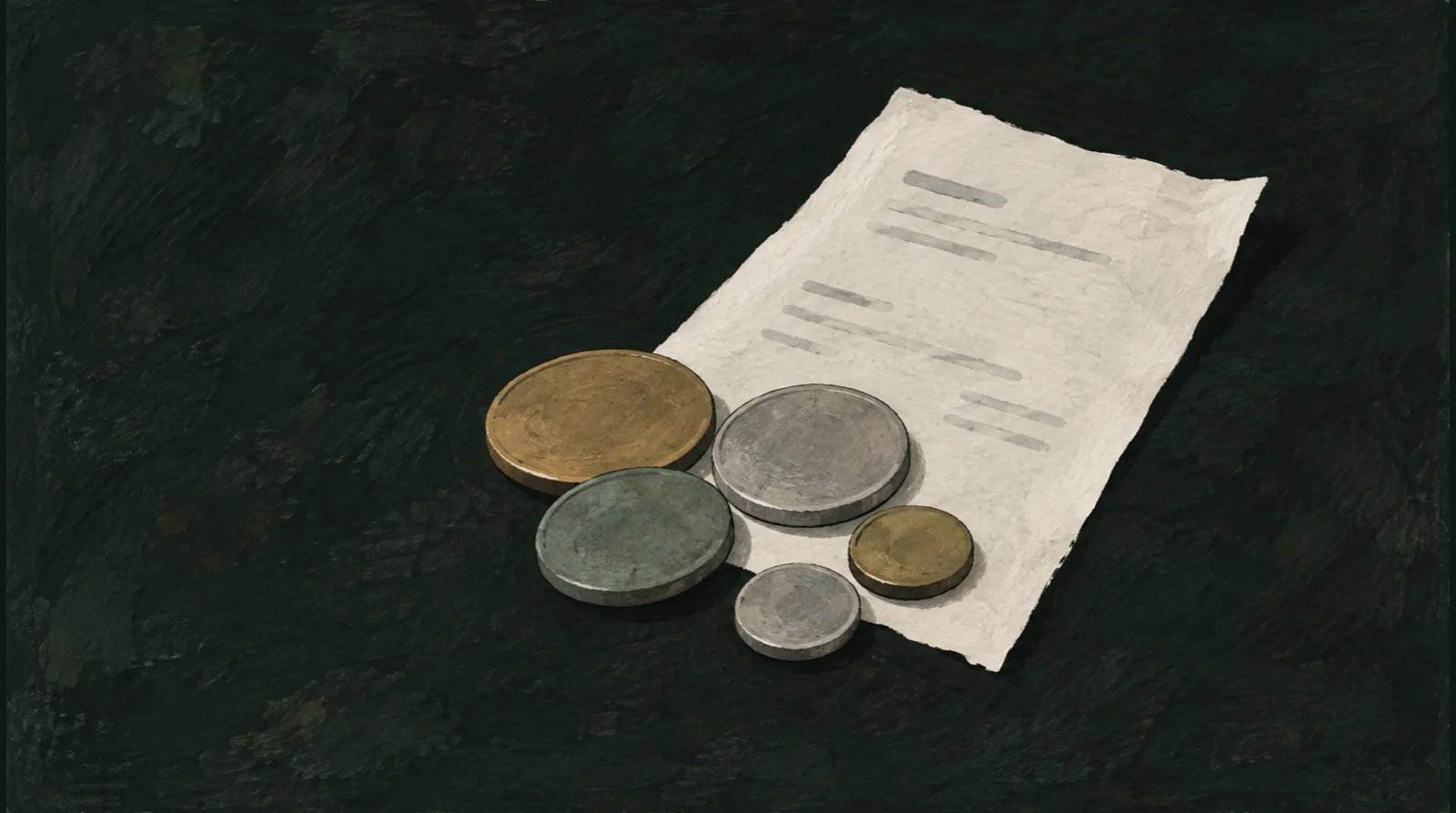
“Rare coin found in change” headlines hide the base rate: the overwhelming majority of circulating coins are worth face value and nothing more. This checklist is built on that honesty — a fast screen for the features that occasionally matter, and a confident end point for everything else.
Three currency systems illustrate the checks — the United States, the United Kingdom and the euro area — because each publishes the official references needed to settle a find. The habit transfers even where the examples don't: check the feature, then check it against the issuing authority's own list.
Most of it is face value — start there
Start from the answer “face value” and let the coin argue otherwise. The features below are the exceptions — a coin that raises none of them goes back in the jar with confidence, which is most of the point of the exercise.
Lists that promise riches in your change are selling clicks. Genuine finds do exist, but they are thin on the ground, and a second look costs seconds rather than a fee — that is the right proportion of effort to reward.
Dates and marks that change the metal story
For U.S. coins, the date alone can change what a coin is made of. Washington quarters dated 1932–1964 and Roosevelt dimes dated 1946–1964 were struck in a 90% silver alloy, while today's dime and quarter dollar are cupro-nickel clad over a copper core — and U.S. half dollars dated 1965 through 1970 sit between the eras in a 40% silver clad composition. U.S. Mint: Coin Specifications, U.S. Mint: First Striking of Half Dollars from New Coinage Material, U.S. Mint: 2014 Biennial Report, Appendix 4
The edge usually tells the story at a glance: a copper-coloured stripe means clad, and a uniform silver-coloured edge keeps the question open — the silver guide runs that check in its proper sequence with weight and magnet.
Small mint letters change things less often than headlines suggest. A mark only means something inside its own issue's context — a common letter on a common year is still a common coin — and the mint-marks guide covers the method for checking one properly.
Design features worth checking twice
The UK's £2 coin is the obvious case. Dozens of commemorative designs circulate beside the definitive types, and the Royal Mint publishes a table of every £2 design with its edge inscription — an unfamiliar £2 can be matched against the official list in about a minute. Royal Mint: £2 Coin Designs
Euro €2 coins work the same way. The European Central Bank explains that each euro-area country may issue up to two commemorative €2 designs per year — regular €2 coins whose national side marks an anniversary or event while the common side stays identical. An unfamiliar €2 reverse is usually a documented commemorative rather than a mystery. European Central Bank: Euro coins
Most unusual-looking features, though, belong to the error-versus-damage question rather than the rarity question. A genuinely doubled die is cataloguable; the flat, shelf-like smear of machine doubling is common and carries no premium — check the shape before the hope. The error-and-damage guide shows the difference.
Edge and lettering oddities
Edges carry design, not just grip. The Royal Mint's £2 table gives each design its own edge inscription, so an edge that reads differently from the listed design is worth a second look — while the inscription's orientation relative to the portrait is random on normal strikes and is not an error. Royal Mint: £2 Coin Designs, Royal Mint Museum: Ask an expert
Apply the same discipline elsewhere: record what the edge says or shows, then compare it with the issue's official specification rather than a headline. A missing or garbled edge feature can be damage, a different variant or a replica — the classification guide handles that last possibility.
What to do with a possible find
Set it aside. Do not spend the interesting one, and do not clean it — the care guide explains why cleaning removes the very evidence a specialist would want. Photograph both sides and the edge in soft light, and record the date, any marks, and what looked odd — the photo guide has the two-minute setup.
Then run the reference check: match the exact design against the issuing authority's list — the Royal Mint's £2 designs, the ECB's euro-coin pages, the U.S. Mint's specifications for the clad-versus-silver edge story. A Coin Says Hi reading on your photos can suggest a possible match to test alongside them — provisional, like everything here. Try it on the find.
If the coin survives all five checks, the value guide's method applies: issue certainty first, grade context second, sold-price evidence third. And keep the base rate in view — most checklist survivors are still face value plus a good story, which is a respectable outcome.
The five-second checklist
Does it cross a known metal or design boundary?
Small letters, checked in the issue's own context
Stripe, lettering or seam worth a second look
Does it match a documented commemorative?
Only worth a look when another flag is already raised
Editorial checklist for circulating coinage; a flag is a reason to check the issue's official reference, not a rarity claim. Evidence: U.S. Mint: Coin Specifications; Royal Mint: £2 Coin Designs; European Central Bank: Euro coins.
Questions people ask
Is a commemorative £2 in my change valuable?
Commemorative £2 coins are made to circulate — designed to be spent — so one found in change is still a £2 until its specific issue's market says otherwise. The Royal Mint's design table lets you name exactly which design you hold; scarcity varies by design, and condition still matters.
I found a silver-era U.S. coin — now what?
For the U.S. examples a finder meets most, the bounds matter: Washington quarters dated 1932–1964 and Roosevelt dimes dated 1946–1964 are 90% silver, and half dollars dated 1965–1970 are 40% silver clad. Earlier series follow their own standards — the 90% standard dates only from the Mint Act of January 1837 — so check the specific issue's reference rather than trusting the year alone. U.S. Mint: 2014 Biennial Report, Appendix 4, NGC: The Coinage of 1837, U.S. Mint: First Striking of Half Dollars From New Coinage Material Then run the silver guide's edge-and-weight checks, and apply the value guide's method — check the issue, not just the metal.
The edge lettering is upside down — is that an error?
Not on a UK £2 — the Royal Mint Museum notes the inscription's orientation relative to the portrait is random and does not count as an error. Record the wording instead and compare it with the design's official listing.
Are the “rare coin in circulation” stories real?
The finds are real occasionally; the base rate is low. Genuine rarities do surface in change, but the honest default is face value until a coin argues otherwise — run the checklist first and the hype last.
Sources and scope
The U.S. Mint's specifications, its 1965 half-dollar release and its 2014 biennial report appendix document the U.S. clad and silver compositions named above, and NGC's Coinage of 1837 supports the 1837 bound on the 90% standard; the Royal Mint's £2 design table and the ECB's euro-coin page support the UK and euro-area commemorative examples; the Royal Mint Museum note covers £2 edge-lettering orientation only. The five-point checklist is Coin Says Hi's editorial method. Nothing here is a rarity determination or a valuation — it is a screen for which coins deserve a closer reference check. Sources last checked 2026-10-01.
Spotted an error? Tell us — include the page address and what seems wrong.