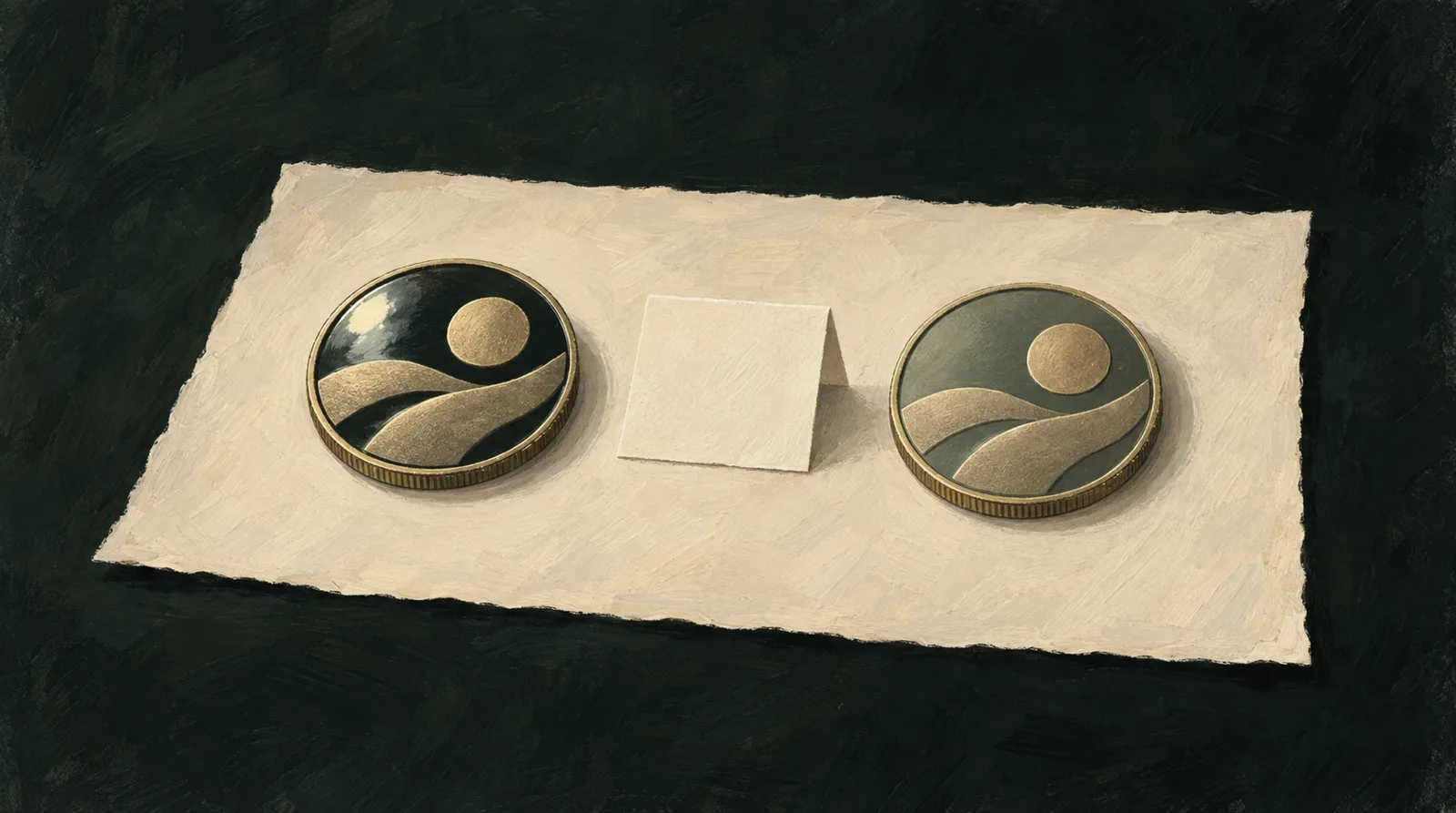
The confusion is built into the vocabulary: "proof" sounds like a verdict on quality, "uncirculated" sounds like a verdict on wear, and "bullion" sounds like a verdict on value. In practice these are labels for different things, and listings freely mix them. This guide separates the mint's labels from the wear words — so a shiny photograph stops doing the seller's persuading for them.
None of this assigns your coin a finish, a grade or a price. It gives you the questions that turn a label into a checkable claim — the coin-terms glossary covers the wider vocabulary, and this guide stays on the four words sellers abuse most.
Four labels, three different meanings
Start with the mint's own vocabulary. The Royal Mint describes producing coins to several distinct striking standards — naming Proof, Brilliant Uncirculated and Bullion among them, each with its own finish and intended buyer. A striking standard is a production decision: how the dies and blanks are prepared, how many times the coin is struck, and how carefully it is handled afterwards. "Proof" and "BU" are therefore answers to "how was this made?" — asked at the mint, before the coin meets the world. Royal Mint: Coin Striking Standards
"Uncirculated" belongs to a different axis. The Royal Mint's glossary defines it as a coin that has never been used and so retains all or most of its original lustre — a statement about the coin's life after the mint, not its birth at it. And "bullion" is a third thing again: a product category priced on metal content rather than a finish description at all. Four words, three axes — method of manufacture, state of preservation, and basis of pricing. Royal Mint: Coin Collecting Glossary
How proof coins are actually made
Proof is the label with the most to decode. The Royal Mint's glossary defines proof coins as specially struck for collectors using polished dies and blanks, producing a mirror-like field with raised design areas that appear frosted. The Royal Australian Mint's glossary puts the crucial line plainly: proof is a method of manufacture, not a condition or grade. Royal Mint: Coin Collecting Glossary, Royal Australian Mint: Coin Glossary
The production difference is real labour. The Royal Mint describes its Proof and Brilliant Uncirculated commemoratives as struck more times than circulating coins — which are struck once — and individually inspected by hand, with imperfect pieces excluded from sale. That extra striking is what presses full detail into polished metal; the mirror field is the fingerprint of the process, not of careful ownership. Royal Mint: Why Pay More For a Coin
On certified holders the same idea appears as a code: NGC places a two-letter strike-type prefix before the numeric grade, using PF for coins struck in a special format for collectors, MS for coins struck in the format of circulation issues, and SP for specimen pieces that fall between the two. A "PF 68" label is therefore two facts at once — how it was made, and how it has kept. NGC: Grading Scale
Uncirculated versus mint state
Now the word that causes the most trouble, because three different systems use it. In a mint's product list, "Brilliant Uncirculated" names a striking standard — the Royal Mint glossary describes BU coins as struck to a higher standard than circulating and bullion issues, with good design detail but lower definition than Proof. In plain English, "uncirculated" is a wear claim — never used, original lustre intact. And in the U.S.-style numeric system, "Mint State" covers the no-wear end of the scale: NGC's MS code applies to grades 60 through 70. Royal Mint: Coin Collecting Glossary, NGC: Grading Scale
The same listing word can therefore be a mint standard, an informal claim, or shorthand for a numeric range — and the coin's packaging and price usually reveal which the seller means. Two honest cautions follow. A coin can be genuinely never-circulated yet still carry marks picked up at the mint itself: the Royal Mint's glossary even names these "bag marks", contact nicks from coins jostling in mint bags. And an uncirculated circulating-strike coin is still not a proof — the dies, blanks and handling differ before wear ever enters the question.
Bullion is a category, not a finish
"Bullion coin" tells you how the coin is priced, not how it was finished. The Royal Australian Mint defines bullion coins as coins made from precious metals, often valued by weight rather than face value; the Royal Mint defines bullion as precious metals in the form of bars, coins or ingots. Neither definition mentions a surface standard. Royal Australian Mint: Coin Glossary, Royal Mint: Coin Collecting Glossary
That is why bullion pieces can arrive looking ordinary: the Royal Mint notes its own bullion coins share a finish quality similar to circulating coins while being struck from precious metals. A bullion label is a claim about content and pricing basis — the melt-value guide explains the arithmetic that flows from it — and says nothing about whether the surfaces are proof, BU, or workaday. Royal Mint: Why Pay More For a Coin
Finish versus condition: the two independent axes
The cleanest mental model is a grid. One axis is how the coin was made — the mint's striking standard. The other is what has happened to it since — wear, handling, storage. The mint fixes the first at birth; time writes the second. A proof coin that spent years in a drawer of loose change is still a proof by manufacture and worn by condition, and graders have a name for exactly that: NGC's details-grading glossary lists "Impaired" for proof coins that received light circulation or mishandling while keeping detectable proof surfaces. NGC: Details Grading
One coin, two questions
Circulation strike, BU, proof: fixed at the mint
Worn through to untouched: written afterwards
A proof can be worn; a circulation strike can be mint-fresh
A finish word plus a condition word describe one coin
Editorial summary; the two axes are independent. Evidence: Royal Australian Mint: Coin Glossary; NGC: Details Grading.
The practical corollary: no amount of polishing moves a coin back along the condition axis. Wear cannot be un-worn, and harsh cleaning adds new damage — grading services treat whizzed, wiped or improperly cleaned surfaces as problems rather than improvements, and the Royal Canadian Mint advises inexperienced collectors to avoid cleaning altogether, as the care guide explains from the handling side. NGC: Details Grading, Royal Canadian Mint: Coin Care
When sellers misuse the words
Because these labels carry a whiff of prestige, listing language stretches them. Three patterns are worth knowing. "Proof-like" or "prooflike" sounds like proof but names something else entirely: NGC's strike-character list applies PL to non-proof coins whose fields happen to be mirrored — the designation explicitly does not apply to actual proof coins. A "prooflike" coin is a circulation-format strike with a shiny surface. NGC: Grading Scale
"Uncirculated" gets used loosely for anything bright — though a polished coin can look bright while being damaged, since services note that whizzing is done precisely to simulate mint lustre on a circulated coin. And "bullion" or "silver" framing can appear on plated or replica items, where the label borrows the credibility of a pricing category the object does not belong to — the U.S. Mint maintains consumer alerts covering misleading coin marketing and replica sales for exactly this reason. NGC: Details Grading, U.S. Mint: Consumer Information
The check that cuts through all of it: a finish label is a claim about what the mint sold. Ask whether the issuing mint offers that design in that finish, on the issuer's own product or archive page, and whether the piece in front of you matches that description — its packaging, certificate and stated standard included. The catalogue-reading guide covers the verification step in detail, and the counterfeit guide covers the harder case where the object itself is not what the label claims.
Questions people ask
Is a proof coin always worth more than an uncirculated one?
No — the words sit on different axes, so they do not rank against each other. A proof is made a particular way and can still be worn or damaged; an uncirculated claim is about wear. Price follows the specific issue, its demand and its condition together — the value-drivers guide covers that machinery, and the value-from-a-photo guide covers what a listing's photo can't tell you about it.
My coin is mirror-shiny — does that make it a proof?
A mirrored field is consistent with a proof finish, but it is not proof of proof: prooflike circulation strikes have mirrored fields too, and a cleaned coin can photograph far better than it grades. Check whether the issuer sold that issue in a proof edition and compare the piece against its description.
Does "BU" mean the coin is perfect?
Brilliant Uncirculated names the mint's striking standard — higher than circulating production, below proof definition. It is not a perfection promise; mint handling can leave contact marks on any new coin.
Can a worn coin be made uncirculated again?
No. Wear is permanent metal loss, and the improper cleaning — polishing, whizzing or badly judged dipping — sold as "restoration" can create new surface problems that grading services treat as details-grade issues. Honest conservation is a professional decision, not a home treatment.
Does Coin Says Hi tell me my coin's finish?
A reading describes what the photos show — a possible match, visible clues, alternatives — so finish-like evidence can appear among the clues. It does not certify a striking method or a grade. Use a possible match as the starting point for checking the issue's own finish editions. Try it on your coin.
Sources and scope
The Royal Mint's striking-standards and glossary pages support the striking-standard framing and the Proof, Brilliant Uncirculated, bullion, uncirculated and bag-mark definitions; its "why pay more" page supports the multiple-striking, hand-inspection and bullion-finish descriptions for that mint's own products — other mints describe their own standards. The Royal Australian Mint's glossary supports the proof-is-a-method-not-a-grade statement and the bullion-coin definition. NGC's grading-scale and details-grading pages support the MS/PF/SP strike codes, the prooflike designation's exclusion of actual proofs, the impaired-proof and whizzed descriptions, and the 60–70 no-wear range. The Royal Canadian Mint's coin-care page supports the advice to inexperienced collectors to avoid cleaning. The U.S. Mint's consumer-information page supports the existence of official consumer alerts on misleading coin marketing; the cited URL is the Mint's canonical page. Finish vocabulary varies by country and era — the issuing mint's own edition description is the final word on any specific coin. Sources last checked 2026-10-01.
Spotted an error? Tell us — include the page address and what seems wrong.