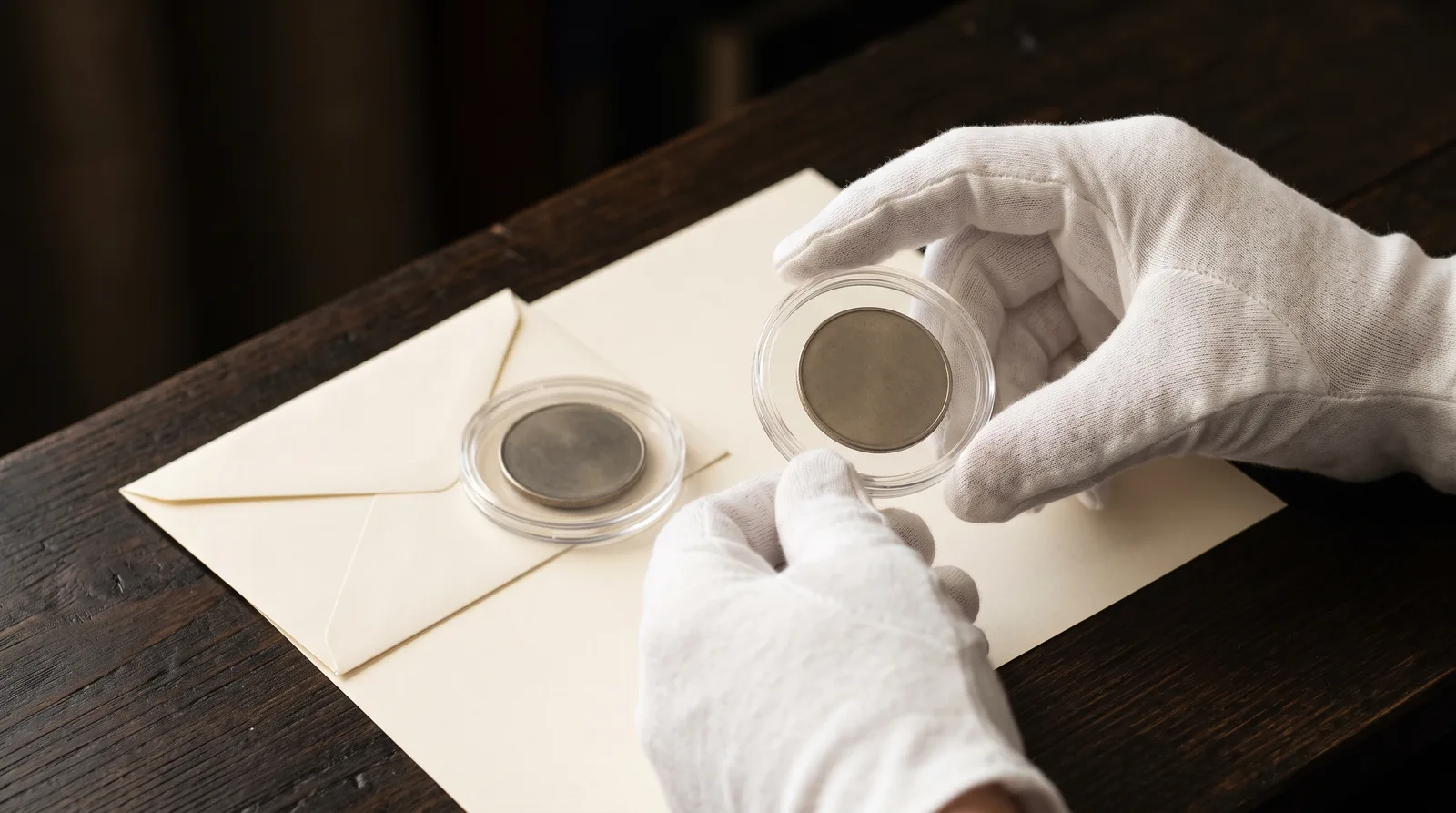
Before you decide what a coin is or what to do with it, preserve the information and condition you already have. Keep related notes and packaging, avoid rubbing the surfaces, and make a record of both sides. A careful first hour can make later research much easier.
This guide is for beginner handling and documentation. It is not a conservation treatment manual, an appraisal or advice about the legal ownership of found objects. Rules for finds, export and ownership vary by location; obtain the relevant local guidance if those questions apply.
Pause before making the collection look better
It is tempting to wash a dull coin, polish a dark patch or remove a surface deposit so the design looks clearer. The Royal Canadian Mint advises inexperienced collectors to avoid cleaning, including wiping with a soft cloth. NGC explains how improper cleaning can affect a coin’s certification result. Use that as a reason to avoid improvised treatment while the object is still unfamiliar. Royal Canadian Mint: Coin Care, NGC: Details Grading
This does not mean that all surfaces should receive the same professional treatment. It means a beginner should not select a treatment from appearance alone. If a surface appears unstable or the coin is embedded in another material, document it and seek appropriate conservation advice.
Do not use a price listing to justify cleaning: “it might be valuable” and “it would look better” are not treatment plans. Photography and careful reference comparison are the next steps in this guide.
Set up a place where mistakes are less likely
Choose a clean working area with a soft surface. Work with one coin at a time. Keep any envelope, holder or handwritten note next to that coin while you record it. Give the record an ordinary identifier such as “Collection A, coin 01.” This label is organizational; it does not identify the issue.
Handle a coin by its edges where practical and avoid touching the faces. The U.S. Mint and Royal Canadian Mint provide handling advice focused on avoiding surface contact. Follow a holder’s intended handling rather than prying it apart for inspection. U.S. Mint: Caring for Your Coin Collection, Royal Canadian Mint: Coin Care
Do not stack loose coins as a sorting shortcut. Keep a clear separation between items while recording them. A tray or small groups of labeled holders can help, but you do not need to buy a specialized system before you have made an inventory.
Keep the evidence together before reorganizing
Packaging, labels and supplied notes
One identifier; photographs of both faces
Suitable individual storage; stable environment
Editorial sequence; no conservation treatment instructions. Evidence: Royal Canadian Mint: Coin Care; U.S. Mint: Caring for Your Coin Collection; Canadian Conservation Institute: Basic Care of Coins, Medals and Medallic Art, Note 9/4; Canadian Conservation Institute: Storage of Metals, Note 9/2.
Keep notes and packaging with the evidence
Record where the coin came from as accurately as you can, separating known history from family recollection or a seller’s claim. “Envelope labeled 1921” is a fact about the envelope. It is not confirmation that the enclosed coin was issued in 1921. Photograph the label as well as the object.
Useful record fields include:
| Field | Example of careful wording |
|---|---|
| Record identifier | Collection A, coin 01 |
| Supplied label | Envelope says “old silver”; composition unverified |
| Visible date | 19?1; third digit unclear |
| Photographs | Side A and Side B; holder still present |
| Existing holder | Sealed holder; not opened |
| Research status | Candidate issue found; reverse not yet compared |
| Next step | Read official issue reference; arrange specialist check if needed |
Avoid replacing original notes with a neat but unqualified summary. Preserve the original and add your interpretation separately. This is particularly useful when a later reference contradicts an earlier label.
Choose storage for the material, not the appearance
The U.S. Mint’s collection-care guidance discusses suitable holders and storage conditions, and the Royal Canadian Mint recommends PVC-free storage and acid-free sleeves. Use products intended for coins and check the material specification rather than assuming every clear plastic sleeve is equivalent. U.S. Mint: Caring for Your Coin Collection, Royal Canadian Mint: Coin Care
Canadian Conservation Institute guidance addresses coins, medals and medallic art, including the effects of the environment and storage materials. It is institutional conservation guidance; the procedures and chemicals discussed there should not be turned into a beginner DIY recipe. For this workflow, take its preservation lesson: material and environment matter, and treatment choices need appropriate expertise. CCI: Care of Coins, Medals and Medallic Art
Keep storage away from avoidable moisture and contaminants, and check holders and surroundings periodically. Do not describe ordinary home storage as museum-grade or guaranteed protection. If you see changes, photograph them and seek advice rather than immediately applying a household remedy.
Documentation and storage do different jobs
Record the original label, both sides, source links and uncertainty.
Use suitable material, separate items and monitor the surroundings.
Preservation workflow; neither column certifies identity or value. Evidence: U.S. Mint: Caring for Your Coin Collection; Canadian Conservation Institute: Basic Care of Coins, Medals and Medallic Art, Note 9/4; Canadian Conservation Institute: Storage of Metals, Note 9/2.
Investigate identity before investigating price
Begin with the identification guide: both sides, readable text, issue reference and documented uncertainty. Then examine small marks in their country and issue context. Avoid sorting coins into “valuable” and “worthless” piles from a portrait or colour alone.
Coin Says Hi may suggest a possible identification from submitted photos, with visible clues and next checks. It does not assess authenticity, formal grade or market value. Keep its suggestion as a lead in the record, together with the reference you checked independently.
If you want to sell, insure or buy a coin, a professional assessment may be appropriate. Prepare the photographs, labels and source notes first; they make it easier to explain what you know and what you still need to resolve. Our value research guide explains why a matching photograph is only the start of that task.
Questions people ask
Should I remove an inherited coin from its holder?
For this beginner workflow, leave existing holders intact while you record and photograph them. If a holder obscures evidence or may be unsuitable, seek advice before changing it. Do not break a sealed grading holder merely to improve a picture.
Is a dark surface dirt that should be removed?
Appearance alone is not a treatment diagnosis. Record it, use a different lighting angle and avoid rubbing or polishing. NGC’s details guidance explains why surface problems and improper cleaning matter to assessment.
Can an old handwritten label be trusted?
Treat it as part of the collection’s documentation. Quote it accurately and verify its claims against the coin and appropriate references. A label can be informative without being conclusive.
What if I found the coin outdoors?
Record the circumstances, avoid cleaning and obtain appropriate local guidance on finds and ownership. This article makes no country-specific legal claim about reporting duties or title.
Sources and scope
The U.S. Mint and Royal Canadian Mint supply coin handling and storage guidance. NGC explains its own grading treatment of details problems. CCI supplies Canadian institutional conservation guidance for coins and medals. The inventory sequence is Coin Says Hi’s editorial method; it is not a conservation protocol or appraisal.