A coin with doubling, a missing area, a raised line or an odd rim sends most finders to the same hopeful question: is this a valuable mint error? The honest base rate is sobering — the large majority of odd-looking coins are ordinary circulation damage or minor production variation worth no premium at all. But a minority really are mint errors or documented die varieties, and telling them apart is a learnable skill.
This guide gives you the working categories and the documentation method. It is not an attribution service, and no photograph — yours or ours — can certify that a feature is a genuine error. Where money depends on the answer, a specialist decides.
Before you call it an error
Three words get used loosely online, so fix them first. A mint error is a coin struck wrong at the mint: a clipped planchet, an off-center strike, a brockage. A variety is a repeated characteristic of a specific die — every coin struck by that die shares it, which is why varieties can be catalogued and attributed. Damage is everything that happened after the mint: scratches, dents, corrosion, bends, glue, tooling marks and deliberate alterations.
The practical consequence: errors and varieties are mint-made and finite, so specialists can document them. Damage is random and effectively unlimited, which is why “odd” alone is never evidence of “error.” Start from the assumption that the feature is damage or an ordinary production quirk, and let the evidence move you — not the listing that sold a different coin for a surprising price.
Mint-made features vs post-mint damage
Mint-made features tend to look like they belong to the striking process: metal flowed into or away from a space, and the surrounding design usually shows it. A clipped planchet loses an area before the strike, so the rim and design weaken symmetrically toward the gap. Post-mint damage sits on top of the design: it cuts across letters, distorts metal that was already struck, or removes material the strike had placed.
Ask of any oddity: does the design behave as if this happened during manufacture, or does it look imposed afterward? A letter that is doubled in a way the die could not produce is damage. A rim that is bent rather than missing is damage. Where the surface itself is the question, remember that NGC's details grading exists precisely because surface problems — cleaning, corrosion, tooling, damage — change how a coin is assessed, whatever caused them. NGC: Details Grading
Doubled die vs machine doubling
This is the confusion that fills collector forums. A doubled die is created when the die itself is manufactured with a duplicated, rotated or offset image — every coin it strikes then shows the same distinct doubling, typically with rounded, separated secondary images that look like part of the design. NGC's doubling explainer describes exactly this mechanism. NGC: Doubled Dies vs. Machine Doubling
Machine doubling — also called strike doubling or shelf doubling — happens during the strike, when the die shifts minutely and drags or flattens the design. The result looks like a flat, shelf-like smear beside a letter or numeral rather than a second complete image. It is common, it varies coin to coin, and it is not a catalogued variety — which is why experienced collectors shrug where beginners hope. The ANA's error-coin explainer likewise names press vibration and instability as its cause. ANA Reading Room: Error Coin Essentials — Doubling
Round and separated versus flat and shelf-like
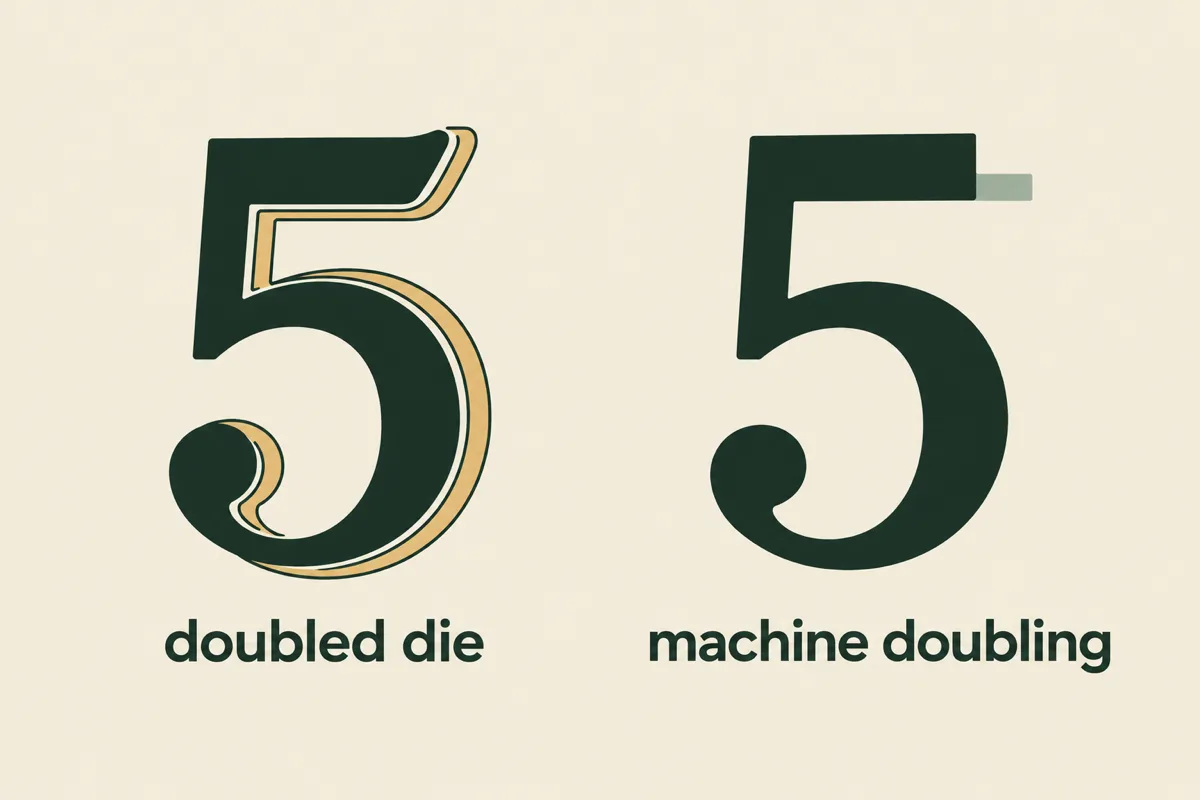
- Doubled die — secondary image is rounded, separated and repeatable across coins from that die
- Machine doubling — flat, shelf-like drag marks that vary coin to coin and carry no premium
Teaching diagram of the two doubling types; the shape distinction follows NGC's description of doubled dies versus mechanical (strike) doubling. Evidence: NGC: Doubled Dies vs. Machine Doubling.
The field rule: look at the shape of the secondary image. Rounded, separated, complete-looking doubling on letters and date suggests a doubled die worth comparing against documented varieties. A flat ledge beside the same characters is almost always machine doubling.
Clips, off-centers, cracks and cuds
Four more mint-made features have settled names worth knowing:
- Clipped planchet: the blank was punched with an overlap, so a curved or straight section is missing from the edge — the design fades toward the gap rather than ending sharply.
- Off-center strike: the die struck off alignment, leaving part of the blank unstruck — the date and mint mark surviving in the struck area usually decide how interesting collectors find it.
- Die crack: a crack in the die fills with metal at the strike, leaving a raised line on the coin — common on older issues, usually a curiosity rather than a premium.
- Cud: a die piece breaks away at the edge, so the strike leaves a raised, featureless blob attached to the rim — more interesting than a hairline crack because the die literally lost part of itself.
Each of these is mint-made, but “mint-made” is a category, not a price. Rarity within the type, eye appeal and whether the issue is documented all matter before any premium exists — and each has lookalikes produced by damage, which is why confirmation needs a reference or a specialist rather than a photograph alone.
Photographing an anomaly for comparison
Document the feature before you research it, because comparison images are what you will argue with. Photograph the whole side first, then a closer view that keeps the feature's position readable — a tight crop of a doubled letter without its surroundings is hard to compare against any reference. The photography guide covers the repeatable setup.
Raking light — light skimming across the surface at a low angle — is what makes raised lines, shelf doubling and flow patterns readable. Take a second image from a different angle when the first leaves shadows ambiguous. Record where the feature sits (“inside the second digit,” “from rim to portrait”) and do not enlarge, paint over or sharpen the anomaly in an editor; a cleaned-up image argues for nothing.
Coin Says Hi's reading can add useful context here: its visible clues and alternatives describe what is actually on the photo, which is the same disciplined observation you need before comparing with a documented variety. Treat the output as notes to verify, not an attribution.
When specialist attribution is worth it
Work through documentation first: candidate error type, position, both sides photographed, reference images compared. If the coin still looks like a doubled die, a genuine clip or an off-center strike after that check, then a specialist opinion becomes reasonable — variety attributors and grading services handle documented errors, and a real error is exactly what their process is for.
What is not worth it: paying an attribution or grading fee for shelf doubling, a damaged rim or a corroded patch. The U.S. Mint's specifications are a useful sanity check at this stage — a feature that contradicts how the denomination is manufactured is usually damage, not a marvel. U.S. Mint: Coin Specifications If identification itself is still open, run the identification guide first; you cannot attribute an anomaly to an issue you have not named.
Questions people ask
My coin's letters look doubled — is it a doubled die?
Check the shape before the hope. Rounded, separated, repeatable doubling suggests a doubled die; flat, shelf-like drag marks suggest machine doubling, which is common and unpriced. Compare your images against NGC's doubled-die and machine-doubling examples before paying anyone.
A piece is missing from the edge — is that an error?
Possibly a clip, possibly damage. A clipped planchet was missing before the strike, so the design weakens into the gap; a damaged edge loses metal after striking, which looks different. Photograph it in raking light and compare with reference images of verified clips.
Is a die crack worth anything?
Usually little on its own — die cracks are common and most carry no premium. A few are catalogued as varieties. Record it, check whether your exact issue documents it, and do not pay to attribute a hairline crack.
Can a photograph certify an error?
No — not yours, and not a Coin Says Hi reading. Photos support comparison and give a specialist a head start; certification requires the physical coin in expert hands.
Sources and scope
NGC's doubling explainer describes the doubled-die versus machine-doubling distinction, including the flat, shelf-like look of strike doubling. The ANA Reading Room catalogues the most common doubling forms collectors meet — die wear, plating disturbance and press vibration — and reports that the common forms it covers carry little monetary value. NGC details grading explains why surface problems matter to assessment. U.S. Mint specifications describe how the named U.S. denominations are manufactured. The taxonomy and documentation sequence are Coin Says Hi's editorial method. Nothing here attributes an error, guarantees authenticity or estimates a price.
Spotted an error? Tell us — include the page address and what seems wrong.