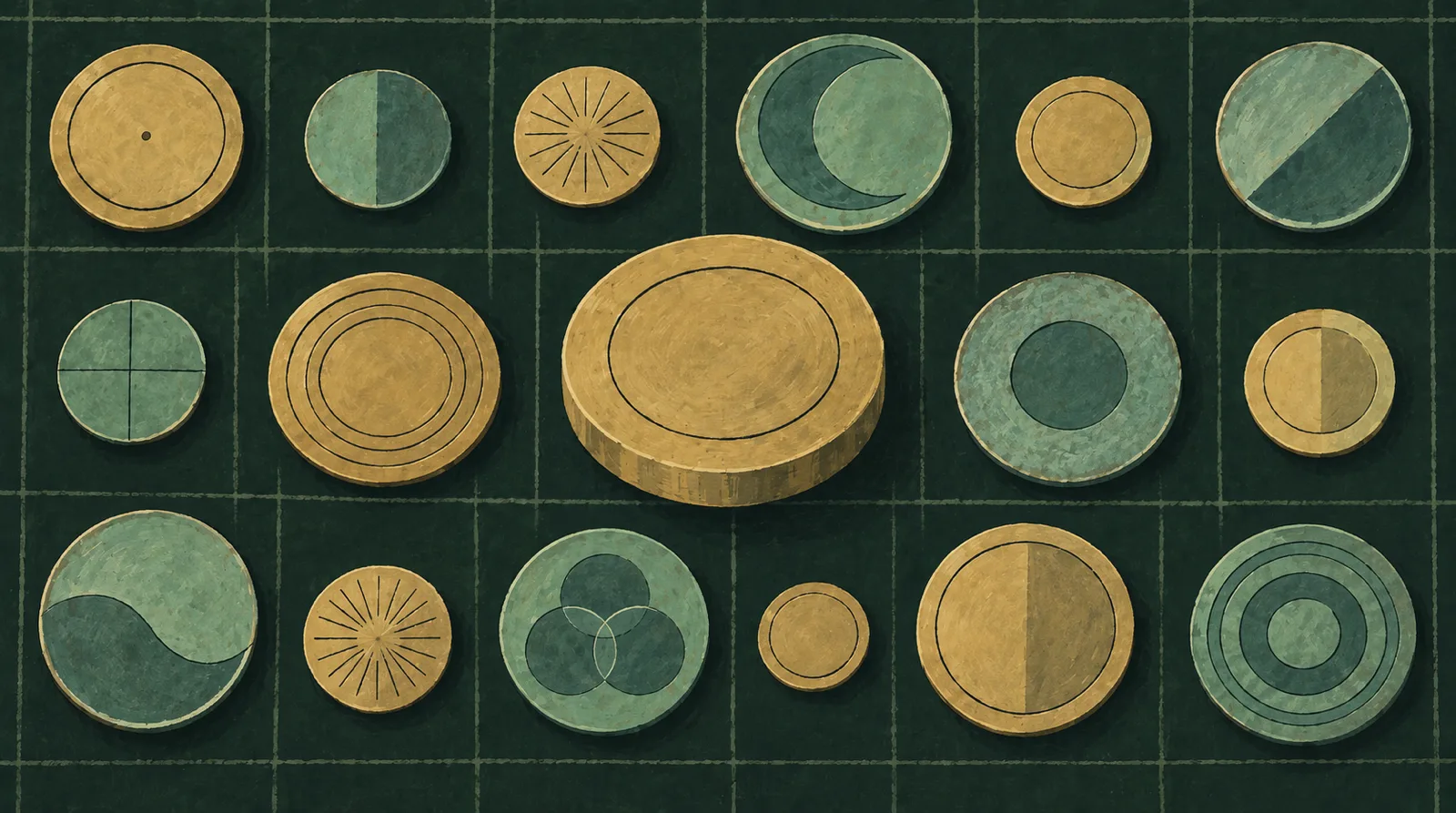
A coin-like object that turns out not to be a coin is not a failed identification — it is a different category of thing. Tokens, medals, souvenir pieces and replicas sit in the same tins and inheritances as real coins, and most of them announce their category once you know what to look for.
This guide sorts the object into a working category so the right reference can take over. It does not authenticate anything: a category is a research direction, not a verdict, and nothing here is a legal opinion or a valuation.
Three questions that classify the object
Three questions, asked in order, classify most coin-like objects. None is decisive alone, but together they narrow the object to one of four families: coin, token, medal or replica.
Who issued it? The Royal Australian Mint's glossary defines a coin as a piece of metal marked with a device, issued by a government authority and intended to be used as money. Both halves matter — a government origin and a money purpose — and the test is who issued the object, not who manufactured it: governments regularly contract private mints to strike their coinage, and Pobjoy Mint's own history describes it as a privately owned facility that held licences to strike legal-tender coins for the Isle of Man and dozens of other governments. What fails the test is a piece issued by the private party itself — a company, an individual, or a mint striking its own products. Royal Australian Mint: Coin Glossary, Pobjoy: The Pobjoy History
Does it carry a denomination? The same glossary defines a denomination as the stated face value of a coin. A stated amount of money is the issuer's promise of spending power; a weight, a purity stamp, a date or an event name is not a denomination.
What was it issued as? Issued as money means carrying monetary status — a denomination the issuing authority stands behind — not necessarily being meant for a pocket. In the UK, for example, the Royal Mint explains that commemorative crowns are intended souvenirs that seldom circulate, yet each issue is authorised by Royal Proclamation under the Coinage Act 1971 and holds legal-tender status. Objects issued without that monetary status — award and souvenir medals, promotional pieces, imitations — belong to the other families however official they look. Purpose remains a useful clue, since an object made to be kept usually names a person, an event or a logo — it is just not a decisive one. Royal Mint: Commemorative crowns
Three questions before any catalogue
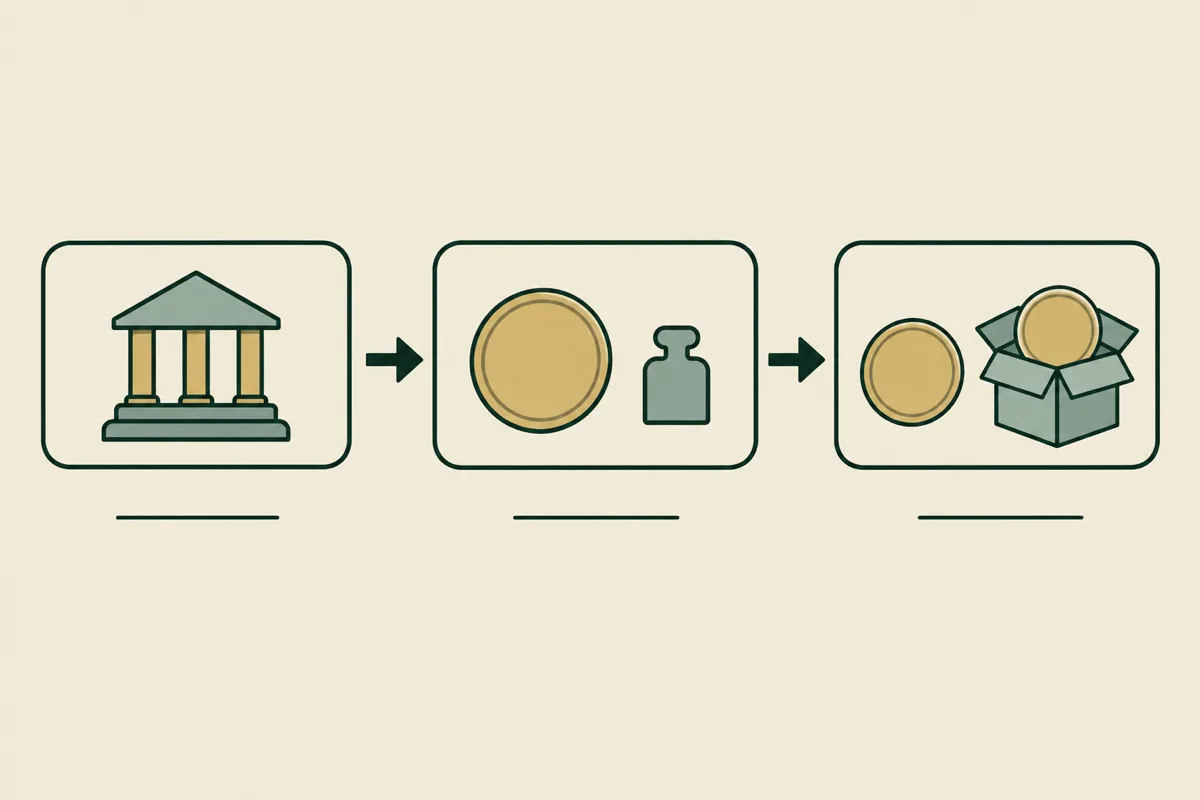
- Issuer — a government authority issuing money, or someone else?
- Denomination — does it state a face value?
- Purpose — issued as money, or made to keep, award or imitate?
Editorial classification sequence; a category is a research direction, not proof of authenticity. Evidence: Royal Australian Mint: Coin Glossary; American Numismatic Society.
Legal tender and denominations
A coin's denomination is a claim about spending power. The Royal Australian Mint's glossary defines legal tender as currency that must be accepted for payment of debts — which is why the printed value matters: it is the amount the issuing authority stands behind. Royal Australian Mint: Coin Glossary
Two cautions keep the test honest. Most circulating coins state a denomination somewhere, but the absence of one is a clue rather than a verdict — conventions vary by country and era, and older or commemorative issues follow their own habits. And the presence of a number is not proof either: tokens and privately made pieces sometimes carry invented “values” that no government issued. Read a denomination as one answer among three, not the whole answer.
Medals, souvenir medallions and replicas are not legal tender no matter what they depict — a replica of a real coin buys nothing. Watch the deliberate exception, though: a commemorative coin can be sold as a souvenir and still be money, since the Royal Mint's legal-tender guidelines expressly cover non-circulating coins. Legal-tender status, not circulation intent, is the dividing line. Royal Mint: Legal Tender Guidelines
Tokens and their modern descendants
The Royal Australian Mint's glossary describes a token as a piece similar to a coin, often issued privately or for limited use — its examples are transit and commemorative tokens. The signature is a local promise: the piece is good for something, somewhere narrower than a whole economy. Royal Australian Mint: Coin Glossary
The family is still producing members. Transit and arcade tokens, parking and vending pieces, casino chips, military-style challenge coins and promotional “collectible” pieces are privately issued objects doing coin-shaped jobs. Privately minted bullion rounds sit alongside them: they can carry a weight and a fineness mark, but a weight is not a denomination and a private mint issuing its own rounds is not a government issuer.
Tokens are collected in their own right — the Professional Numismatists Guild's member directory lists “Tokens & Medals” among dealer specialties — but they resolve in different references from coins. An object that fails every government catalogue may belong on the token shelf instead. PNG: Member Directory
Medals and commemoratives
A medal is made to mark something — a person, an event, an honour — rather than to be spent. The American Numismatic Society studies coins, currency, medals, tokens and related objects together precisely because the boundaries touch: medals are struck on the same kind of presses, by the same kind of institutions, often in the same mints as coins. American Numismatic Society
Issued by a mint does not mean issued as money. When the American Numismatic Society commissioned its medal for the United States' 250th anniversary in 2026, it produced a struck, official-looking object from a venerable institution — for purchase by collectors, not for circulation. ANS: The American Numismatic Society Commissions Semiquincentennial Medal Government mints strike medals and souvenirs on the same terms; the question is never “was a mint involved” but “was it issued as money” — carrying a denomination and legal-tender status rather than made purely to keep.
Legal-tender commemoratives blur the line on purpose. A commemorative coin is still issued as money and carries a denomination; a commemorative medal does not. When an object celebrates an event but names no currency amount, the medal family is the better working hypothesis.
Replicas and the COPY marking
A replica copies a real coin. In the United States, the Hobby Protection Act of 1973 covers imitation numismatic items — the law requires them to carry identifying marks that flag them as imitations, and the FTC's rule sets the size and placement of that disclosure; the familiar word is COPY, marked plainly and permanently on the piece. The U.S. Mint keeps consumer alerts about replica coins, including versions imported or sold without the required marking. FTC: Hobby Protection Act, U.S. Mint: Consumer Information, U.S. Mint: Replicas of U.S. Coins
Read the marking in both directions. A COPY stamp settles the classification toward replica — the object is openly declaring itself a copy. But its absence proves nothing: unmarked imitations circulate despite the requirement, so “no COPY” is not evidence that a coin is genuine. Whether a suspect piece is a lawful replica or a counterfeit made to deceive is the next question — the fakes-and-replicas guide covers that distinction and the verification route.
What the classification changes for identification
The category decides the reference. Coin questions resolve in mint publications and coin catalogues; token and medal questions need exonumia references, specialist dealers or institutional collections — the American Numismatic Society's scope covers exactly these related objects, which is why it is the natural escalation for a genuine mystery. American Numismatic Society
Classification also resets expectations. A replica of a desirable coin does not inherit that coin's price range — collectors value replicas and medals on their own terms, which are usually modest ones. And a token's story can be genuinely interesting without making it a rare coin; the value guide covers how value research stays honest whatever the category.
Coin Says Hi reads submitted photos the same way. If the model reads the subject as clearly not a coin, the reading can return its “not a coin” status rather than naming a match, and a subject it cannot place may instead come back uncertain — either way, a signal to classify first and research second. A possible match on a replica still needs the checks above. To try it, photograph the object for a provisional reading; if the object does prove to be a coin, the identification guide takes over from there.
Questions people ask
There's no denomination on my coin — what is it?
Often a token, medal or privately made round — but read it as a clue, not a verdict. Some genuine issues do not state a face value. Check the issuer and the purpose alongside; if the object names a weight or an event instead of an amount of money, suspect a privately made piece.
My coin says COPY — what does that mean?
In the United States it is the marking federal law requires on imitation numismatic items. The piece is declaring itself a replica: it is not the coin it resembles, and it is not legal tender.
Are tokens and medals ever valuable?
They are collected in their own markets — specialist dealers list them as a distinct specialty. Their prices follow their own history and rarity, not the price guide of the coin they resemble. For what any single piece might bring, the professional-roles guide explains who to ask and the value guide explains how to compare evidence.
Can Coin Says Hi tell a token from a coin?
It can return a “not a coin” reading when the subject does not present as a coin, and a possible match when it does. Both are provisional signals to verify against a reference — not a classification certificate or an authenticity check.
Sources and scope
The Royal Australian Mint glossary supplies the coin, denomination, legal tender and token definitions used above. The American Numismatic Society describes the institutional scope for coins, medals and tokens, and its press release for the commissioned 2026 semiquincentennial medal is the named example of a coin-like object made for collectors rather than as money. Pobjoy Mint's history page supports the issuer-versus-manufacturer distinction — a privately owned facility licensed by governments to strike legal-tender coins. The Royal Mint's commemorative-crowns FAQ and its legal-tender guidelines support the UK exception named above — souvenir coins that still carry legal-tender status; other countries apply their own rules. The FTC's rule page and the U.S. Mint's consumer-alert pages describe the United States COPY-marking requirement and the replica concerns behind it. The three-question sequence is Coin Says Hi's editorial method. Nothing here authenticates, grades or values an object. Sources last checked 2026-10-01.
Spotted an error? Tell us — include the page address and what seems wrong.