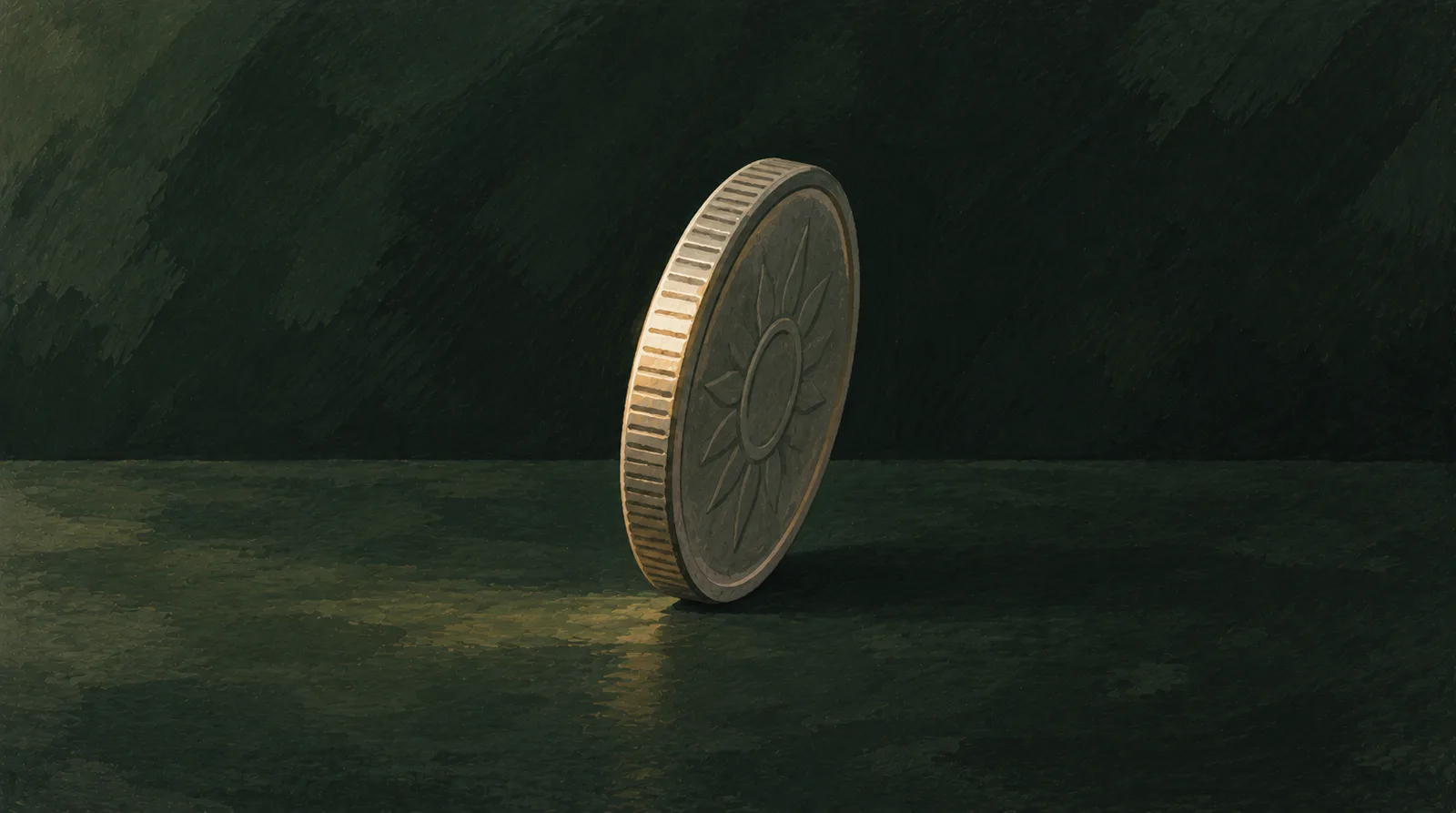
An older silver-coloured coin raises a fair question: is it actually silver, or does it just look that way? The honest answer is that no single home check proves composition — but a short sequence of non-destructive checks can tell you whether silver is plausible, unlikely, or worth confirming professionally.
Every check here leaves the coin exactly as it was. Do not file an edge, scratch a hidden spot, or apply acid to “test” the metal. Those methods destroy the very evidence a later professional needs — and if the coin turns out to be collectible, they remove part of its story with it.
Start with the edge
The edge is the fastest free check, because many modern coins are layered. Look at the coin side-on: do you see a copper-coloured stripe sandwiched between two pale layers, or a single uniform colour all the way through?
For a U.S. example, the Mint's specifications list the current dime and quarter dollar as cupro-nickel clad — pale outer layers bonded to a copper core, which the edge shows as a copper-coloured stripe — while the familiar 90% silver era covers the series a U.S. finder most often holds, such as Roosevelt dimes (1946–1964) and Washington quarters (1932–1964), whose edges appear uniform. The 90% standard itself dates only from the Mint Act of January 1837 — earlier U.S. dimes and quarters were struck to a slightly different fineness, so an old date alone does not mean 90% silver. Half dollars took an intermediate step: U.S. halves from 1965 through 1970 were struck in a 40% silver clad composition before the denomination moved to copper-nickel clad. Always check the exact denomination, series and date range rather than applying one rule to every coin; other countries made their own composition changes at their own times. U.S. Mint: Coin Specifications, U.S. Mint: First Striking of Half Dollars From New Coinage Material, U.S. Mint: 2014 Biennial Report, Appendix 4, NGC: The Coinage of 1837
A uniform edge does not prove silver — plenty of alloys look alike side-on — and a striped edge does not always rule precious metal out for every world issue. The edge is a first filter: a clear copper stripe on a coin whose specification says “clad” is a strong ordinary answer, while a uniform edge on a pre-changeover issue keeps the silver question open.
Two edge stories
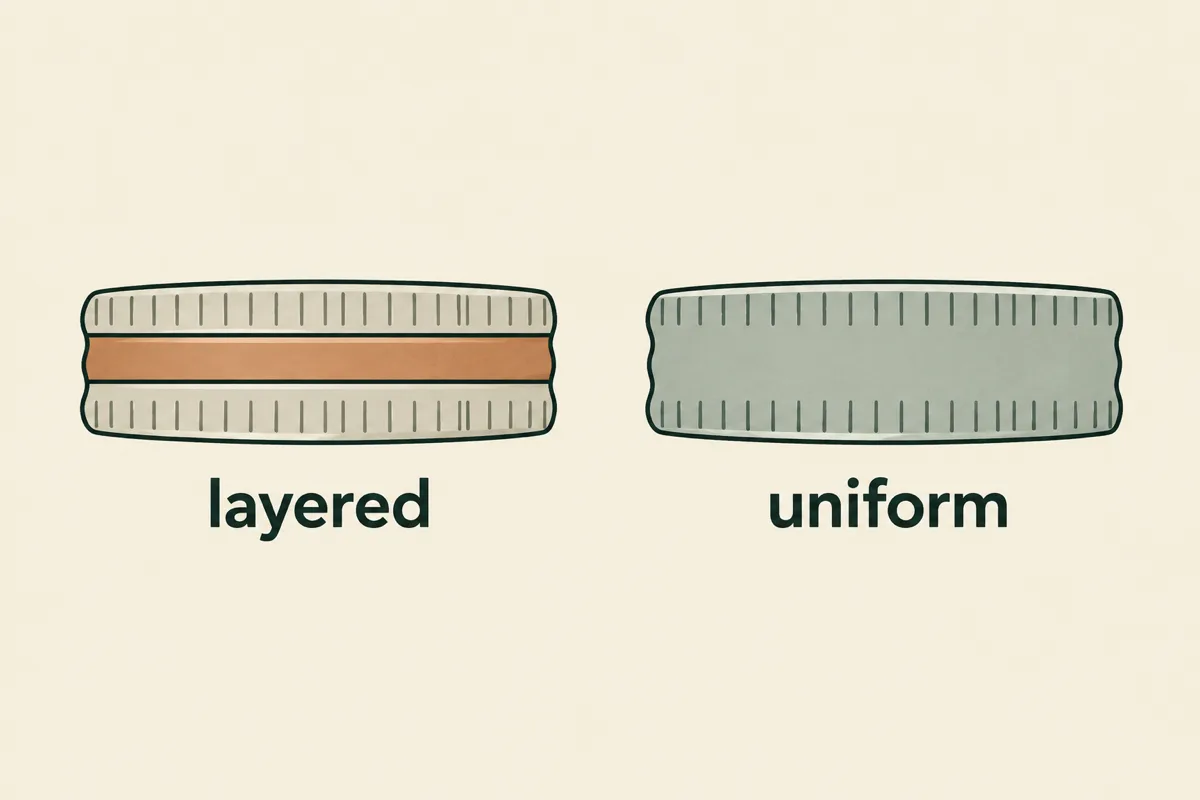
- Layered edge — a visible copper-coloured stripe between pale outer layers suggests clad composition
- Uniform edge — one colour through the edge keeps the silver question open, without proving it
Teaching diagram; the compositions shown follow the U.S. example named in the text. Evidence: U.S. Mint: Coin Specifications; Royal Canadian Mint: Anatomy of a Coin.
Weigh against the official specification
Weight is the strongest home check, because it compares your coin against a published number rather than a feeling. Look up the issuing mint's specification for the exact denomination and issue — not a remembered “normal weight” — and weigh the coin on the most precise scale you have.
The U.S. Mint publishes weight and composition for each circulating denomination, though its table covers coins in current production — for an older silver-era issue, look up that issue's own published specification in the mint's historical documents and reports (the 1964-quarter question below links two for the U.S. standards). For a worked example: if a coin matches the specification's clad weight for its denomination, the silver hypothesis is effectively answered; a weight closer to a silver-era specification keeps the question open. Tolerances and wear mean real coins rarely land exactly on the printed figure. U.S. Mint: Coin Specifications
Record what you measured with: “kitchen scale, reads to 0.1 g” is honest data; a guess is not. The identification guide explains how a measurement sits inside a wider record — measurements support comparison, they do not authenticate on their own.
What a magnet check rules out (and doesn't)
Silver is not magnetic. If a strong magnet pulls the coin firmly, the coin contains a magnetic metal — that is a genuine piece of information. But the reverse is not: many non-silver alloys are also non-magnetic, so a coin that ignores the magnet has merely passed one easy test.
Why we skip the ice and ping tests
Two popular suggestions do not belong on a coin whose story you want to keep. The “ice test” rests a melting ice cube directly on the metal, trading on silver's high thermal conductivity — but direct moisture can spot a collectible surface, and the Royal Canadian Mint's care guidance warns that even tiny, almost invisible drops of saliva can leave impossible-to-remove spots. The “ping” test asks you to balance the coin on a fingertip and tap or drop it — the same guidance recommends holding coins over a thick, soft towel precisely because drops damage coins. Royal Canadian Mint: Coin Care
Beyond the handling risk, both are weak instruments: melt speed shifts with room temperature and contact area, and a coin's ring changes with size, thickness, alloy mix, wear and how it is held. A dramatic result on either check still needs the weight and edge sequence — so skip the folklore and spend the effort on the scale.
What these checks cannot prove
Each check narrows the possibilities; none of them certifies composition, authenticity or value. A plated fake can pass a visual edge check. A worn silver coin can weigh light. A convincing counterfeit can be engineered to match an expected weight — which is exactly why NGC maintains a counterfeit-detection programme for coins where it matters. NGC: Counterfeit Detection
This is also why this guide never asks you to scrape, file or drop acid on the coin. Destructive tests trade a small certainty for permanent damage, and they are unnecessary: better instruments exist, and the professionals who own them test coins all day.
When to stop and get a professional test
Stop home testing when the answer starts to matter — when you are deciding whether to sell, insure or pay a premium for a silver claim. A dealer or assayer with an X-ray fluorescence (XRF) analyser reads a coin's surface composition in seconds without touching it destructively, and for coins where authenticity itself is in question, a grading service's authentication is the stronger route. NGC: Counterfeit Detection
Bring your record: the measured weight, the edge observation and which specification you compared against. That turns a vague “is this silver?” into a checkable claim a professional can confirm or correct quickly. Once composition is settled, our value guide explains how metal content fits into wider research — a silver answer is one input, not a price.
If you want a provisional identification along the way, photograph the coin for Coin Says Hi and include the measured weight in the note field. The reading stays provisional, but a sharper candidate makes every later check easier.
Questions people ask
Is a 1964 U.S. quarter silver?
For that U.S. example, the Washington quarters most people mean — dated 1932 through 1964 — were struck in a 90% silver alloy, while the Mint's specifications give the cupro-nickel clad composition used from 1965 onward; the Mint's Alternative Metals Study records the pre-1965 90% silver standard for the higher denominations, and its 1965 release documents the new-material half dollar. Remember the half-dollar exception: U.S. halves from 1965 to 1970 were 40% silver clad. The 90% standard itself dates only from an 1837 Mint Act — for still earlier U.S. silver, check the specific series rather than assuming the figure. Verify the denomination, series and date range rather than relying on the year alone — and do not apply the U.S. pattern to other countries' issues. U.S. Mint: 2014 Biennial Report, Appendix 4, U.S. Mint: First Striking of Half Dollars From New Coinage Material, NGC: The Coinage of 1837
The coin isn't magnetic — does that make it silver?
No. Non-magnetic simply rules out a magnetic core. Copper, aluminium and the copper-nickel alloys common in coinage are equally non-magnetic — elemental nickel itself is ferromagnetic — so combine the observation with the edge and weight checks.
Can I use an acid test kit?
Acid tests mark the coin and can permanently damage a collectible surface. The non-destructive sequence in this guide answers most questions, and a professional can pick the right non-destructive instrument for the rest. XRF is the common choice, but keep its limit in mind: in metal analysis it is a surface technique whose penetration is often under a millimetre, so a plated or filled fake can still warrant a second method. Thermo Fisher Scientific: A Reader's Question About XRF Safety
Does a dark or rainbow tarnish mean silver?
Colour is suggestive at best. Silver tarnishes dark, but so do other metals, and artificial toning exists. Do not clean or polish the surface to “check” the metal underneath — weigh the coin and compare its specification instead.
Sources and scope
The U.S. Mint specifications are the authority for the current named U.S. denominations; the Mint's 1965 half-dollar release and its Alternative Metals Study appendix support the historical composition dates, NGC's account of the 1837 Mint Act supports the 90%-standard boundary, and the Royal Canadian Mint anatomy and care pages support the structure terms and handling cautions. NGC's counterfeit-detection resource describes professional verification, not a home method, and Thermo Fisher Scientific's XRF explainer supports the surface-analysis limitation noted in the questions. The check sequence is Coin Says Hi's editorial method. Composition, authenticity and value remain professional questions where the answer matters.
Spotted an error? Tell us — include the page address and what seems wrong.