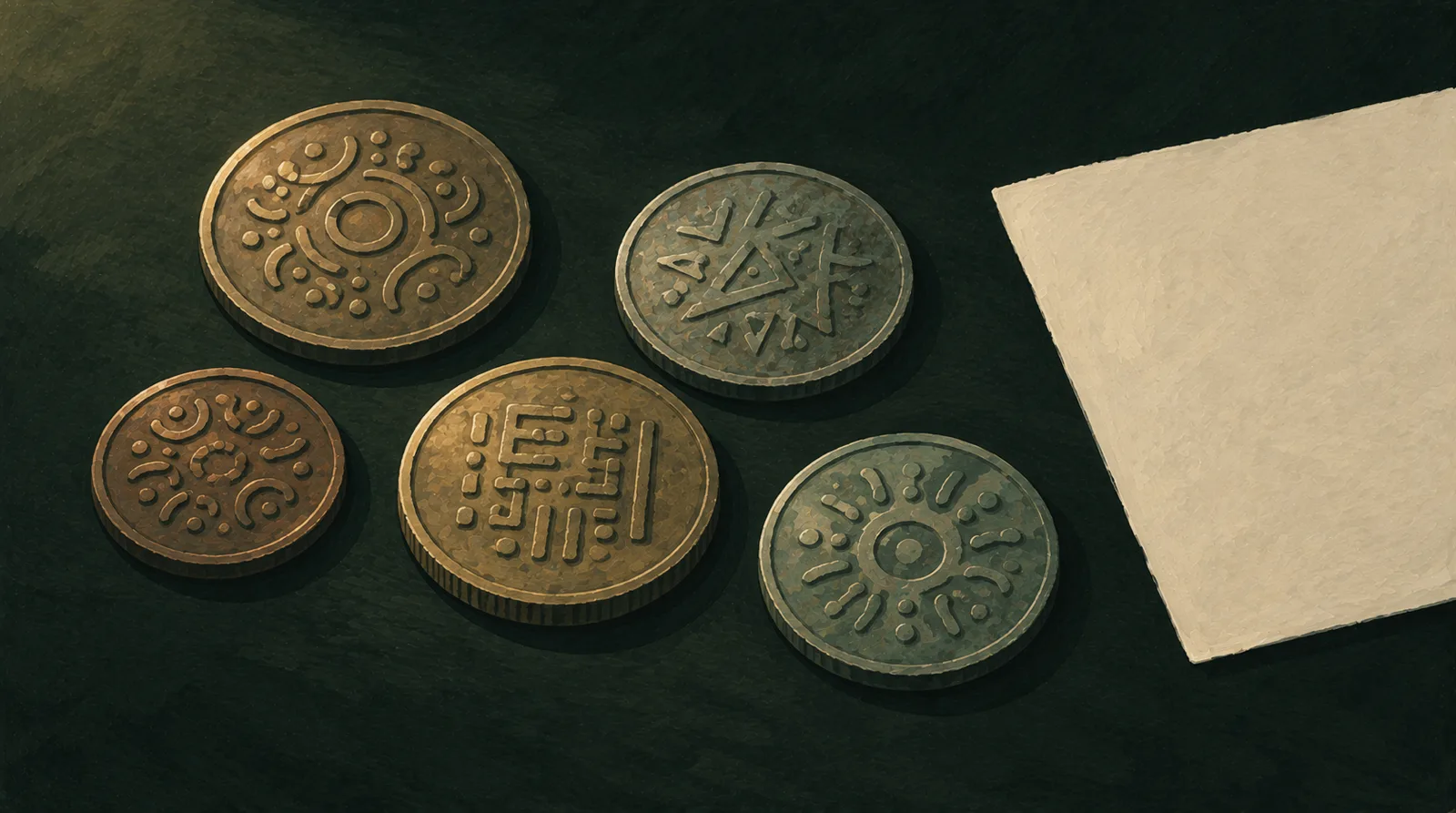
A foreign coin can be fully identified even when you cannot read a single letter of it. The trick is to stop trying to translate first: record the writing as shapes, narrow it to a script family, decode the numbers, and let a world catalogue do the matching. The reading skills you need are mostly copying skills.
This guide covers the triage method for non-Latin inscriptions. It does not teach scripts, and it is not a transliteration service — the examples below are scoped to the issues named, and coin evidence still decides every conclusion.
Copy what you see, even if you can't read it
Photograph both faces sharply, then trace or copy the inscription onto paper exactly as it appears — including the parts you do not understand and the direction the characters sit relative to the design. Do not “correct” a strange shape into a letter you know; a half-remembered alphabet is how a ٥ becomes a 0 and a wrong country.
Preserve the original inscription alongside any attempt to render it in your own alphabet. A transliteration is an interpretation that can be wrong; the photographed inscription is the evidence a better-informed reader can check later. The photography guide covers the setup that keeps small characters legible.
Match the script family first
You do not need to read a script to recognize its family. Match shapes, not meaning:
- Arabic script: flowing connected strokes with dots above and below — used on issues across the Middle East, North Africa and beyond.
- Cyrillic: upright letters with hard-edged shapes — Russia, Bulgaria, Ukraine and several neighbouring issuers.
- Greek: the familiar alpha-omega alphabet — modern Greek issues, with older forms on some commemorative types.
- Hebrew: square block letters read right to left — Israeli issues.
- Chinese characters: square, stroke-dense characters — issues from China, Taiwan and historical series.
- Japanese: Chinese-derived kanji mixed with the simpler, rounder kana — modern Japanese issues often carry the era name in kanji.
- Korean Hangul: circles, lines and square blocks grouped into syllable clusters — South Korean issues.
- Thai: looping, curved letters with circles — Thai issues.
- Devanagari: letters hung from a horizontal top line — Indian issues and several neighbouring scripts with a related look.
A script family narrows the search region; it does not name the country. Arabic script alone spans dozens of issuing authorities, and colonial-era coins mix a local script with English or French. Record which scripts appear on each side.
Match shapes to a writing family
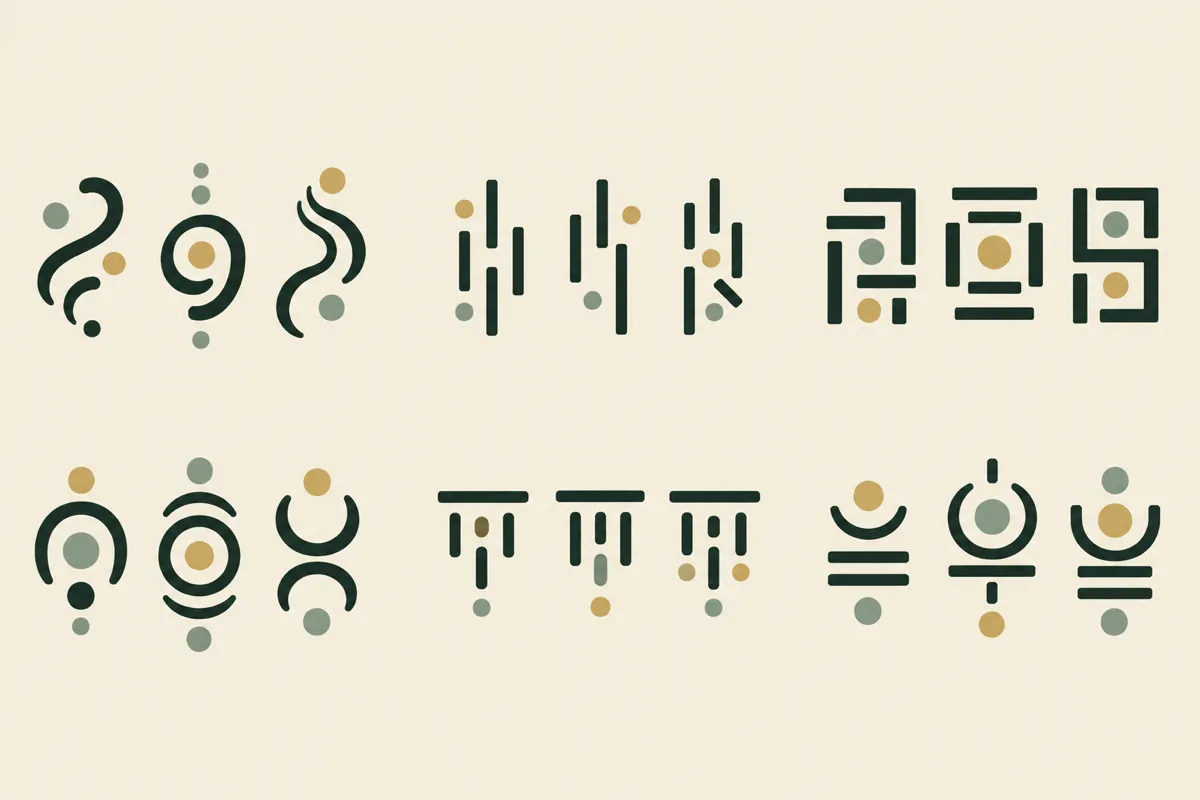
- Flowing with dots — Arabic family; many Middle East and North Africa issuers
- Upright hard-edged — Cyrillic family; Russia and neighbours
- Square stroke-dense — Chinese-derived characters; China, Japan, historical series
- Looped with circles — Thai family
- Hung from a top line — Devanagari family; India and neighbours
- Blocks of lines and circles — Hangul family; Korea
Teaching chart of writing-family shapes for triage only; no coin issue is depicted or implied. Evidence: Numista: World Coin Catalogue; American Numismatic Society.
Numerals and denominations that don't look like digits
Numbers are often the fastest foothold, but many scripts carry their own digit shapes. Eastern Arabic numerals used on coins across much of the Middle East and North Africa — ٠ ١ ٢ ٣ ٤ ٥ ٦ ٧ ٨ ٩ — look nothing like the “Arabic” 0–9 digits used in the West; a coin inscribed ١٤٤٥ carries the number 1445, not an alien string.
Denomination words and symbols also hide in plain sight: a spelled-out unit, a monogram, or a numeral beside a script word. Record every number-shaped and amount-shaped mark with its position — the mint-marks guide applies the same locate-before-interpreting discipline to small symbols.
Era and religious calendar dates at a glance
A readable number can still sit on an unfamiliar calendar. Three systems account for most puzzling coin dates:
- Japanese era years: issues carry the era name plus a regnal year — Japan Mint's official Tokyo 2020 chart pairs Heisei 28 with 2016 and Reiwa 1 with 2019 for those issues. Each era needs its own reference; the pairing is issue-specific, not a formula for every kanji date. Japan Mint: Tokyo 2020 issue chart
- Islamic Hijri years: coins from many Islamic issuers count lunar years from 622 CE. A rough conversion — multiply the Hijri year by about 0.97 and add 622 — lands within a year or two of the Gregorian equivalent, but confirm against the specific issue because calendars and era conventions vary.
- Republic-era years: Chinese issues struck in the Republic era count years from 1912, so adding 1911 to the inscribed year gives the Gregorian year — again, verify the era actually applies to your issue.
Other regional calendars appear too — Thai issues may carry a Buddhist Era year roughly 543 ahead of the Gregorian count, and Israeli issues carry Hebrew dates where letters serve as numerals. In every case the same rule applies: record the inscription exactly, identify the calendar from the issue reference, and never silently “correct” a date into a Gregorian year.
Confirming in a world catalogue
With a script family, a decoded number and the design described, a world catalogue can close the gap. Numista's collaborative catalogue covers world coins by issuer and supports searching by the features you recorded — script, shapes, denomination and imagery — which is exactly the evidence an unreadable coin gives you. Numista: World Coin Catalogue
Compare on several anchors at once, never the script alone: the same writing family covers many issuers, and catalogue thumbnails reward patience. The American Numismatic Society is the institutional anchor for deeper research — its collections and publications exist for coins that outgrow a catalogue row. American Numismatic Society
The identification guide applies here unchanged: candidate, reference, comparison, recorded disagreement. An unreadable inscription just moves more weight onto shapes and numbers.
When the script still doesn't resolve
Partial inscriptions are normal — wear trims letters, strikes clip legends, and some issues carry monograms or ornaments rather than text. Record what survives, state plainly which part is unreadable, and let the design, edge and measurements carry more of the comparison.
This is one place a photo tool earns its keep. Coin Says Hi reads visible lettering and style even when the visitor cannot type it, and the note field can carry your hand-copied inscription so the reading sees the same shapes you do. The result stays provisional — a candidate to check against the catalogue, not a reading service for the script itself. Try it with your photos
For coins that still resist — possible ancients, multiple overlapping scripts, or anything where the stakes justify it — a specialist or an institutional collection is the right next step rather than a forced guess.
Questions people ask
The date looks like ١٣٤٣ — what year is that?
Those are Eastern Arabic numerals for 1343. On a Hijri-calendar issue that is an Islamic year — a rough conversion lands near the mid-1920s Gregorian. Confirm the calendar and era against the exact issue rather than treating the digits as a Gregorian date.
How do I search for writing I can't type?
Search by shapes and evidence instead: script family, denomination structure, imagery, edge and measurements. Numista's catalogue filters let you browse candidates visually, and a clear photo does the typing for you.
Does the script tell me which country issued the coin?
No — scripts travel across borders. Arabic, Cyrillic, Chinese-derived and Latin scripts each cover many issuers, and a single coin can carry two scripts. The family narrows the region; the catalogue match names the issuer.
Can Coin Says Hi read the inscription for me?
It reads visible lettering and design style from your photos and returns a possible match with the clues behind it — useful when you cannot type the script. It stays provisional and does not transliterate or authenticate.
Sources and scope
Numista's catalogue is the reader-facing world reference; the American Numismatic Society is the institutional route for unresolved objects. The Japan Mint chart documents era-date pairs for its specified issues only — the other calendar notes are orientation, not conversion tables. The copy-match-confirm sequence is Coin Says Hi's editorial method, and no result here is an authentication or valuation.
Spotted an error? Tell us — include the page address and what seems wrong.